In 1908, a small book appeared in the United States signed only by “Three Initiates.” The Kybalion: A Study of the Hermetic Philosophy of Ancient Egypt and Greece presented seven principles as the foundations of its system: Mentalism, Correspondence, Vibration, Polarity, Rhythm, Cause and Effect, and finally, Gender.
More than a century later, that final word can easily be interpreted through meanings that became more prominent afterward. But the vocabulary of The Kybalion itself points in another direction. Before asking what “masculine” and “feminine” mean, it is worth asking a more fundamental question:
What is being generated?
It is from this shift in perspective that we can understand the core of this chapter: how potential, development, and expression participate in the emergence of something new. Instead of treating these aspects as isolated concepts, we can observe them as parts of a process of transformation.
First, We Need to Place The Kybalion in Its Own Context

There is a historical distinction we need to make before moving forward: the sequence of the seven principles — Mentalism, Correspondence, Vibration, Polarity, Rhythm, Cause and Effect, and Gender — belongs to the system presented in The Kybalion. It does not appear in this same form in the Corpus Hermeticum and cannot be directly attributed to Hermes Trismegistus.
Historical Hermeticism is much older than The Kybalion, which was published in the early twentieth century. Recognizing this difference does not diminish the value of the principles presented by the book. It simply allows us to understand them for what they are: a modern formulation inspired by the Hermetic tradition, rather than a literal reproduction of an ancient doctrine.
With this distinction clarified, the question is no longer whether the principle is ancient in a literal sense, but rather:
What is this principle trying to communicate?
The Clue in the Word “Gender” Itself
The linguistic history of the word offers a clue. Gender derives from the Old French gendre/genre, connected to the Latin genus, associated with ideas of type, family, birth, and origin. This word family is also related to the reconstructed Proto-Indo-European root gene-, linked to “generating,” and present in words such as generate and generation.
This does not mean that gender can simply be translated as “creation,” since its meanings have changed over time. Even so, this connection with generation and birth helps us understand its use in The Kybalion. For this reason, we can temporarily replace the question “What do masculine and feminine mean here?” with:
“What is being generated?”
“What needs to happen for it to take form?”
I would say that this shift broadens our reading of the principle: instead of reducing it to men and women, we begin to observe how a possibility becomes manifestation.
What Does the Principle of Gender Really Propose?
Within the metaphysics of The Kybalion, Gender would be a principle present across the different planes of existence, manifested through the Masculine and Feminine aspects. The book does not limit them to a sexual meaning, but relates them to the idea of generation.
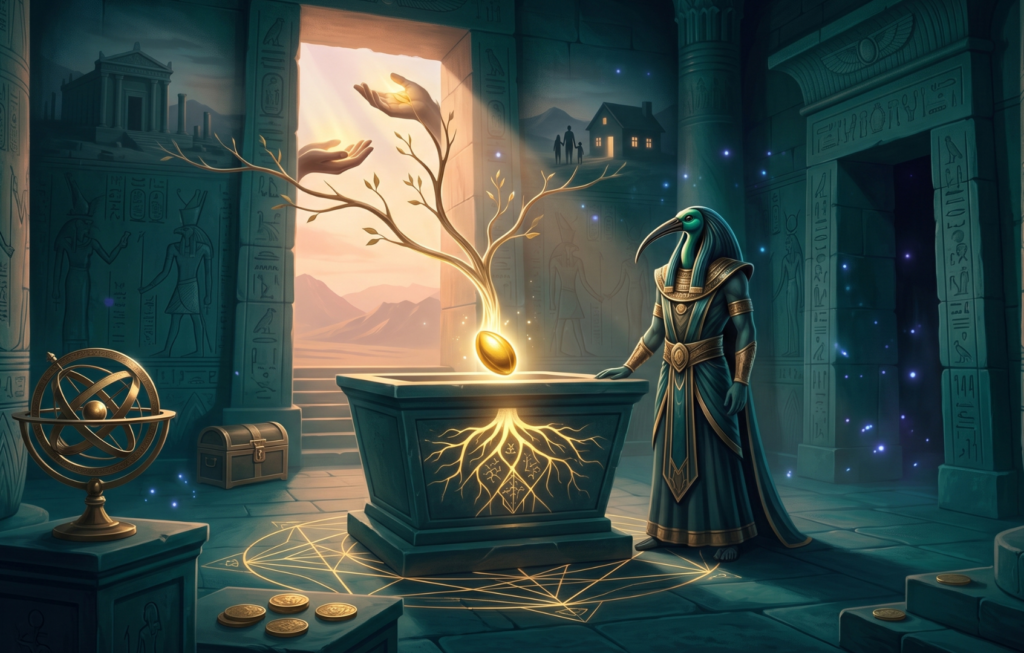
A simple way to visualize this is to think of a seed. It contains a possibility, but it needs conditions, development, environment, and time in order to become a tree:
possibility → conditions → development → form.
The analogy reveals the difference between potential and manifestation. Something may have the capacity to develop without necessarily coming to assume a form. Potential, by itself, does not guarantee realization.
The same happens in our lives: a business idea, a book not yet written, a career change, or a habit we want to develop. In all of these cases, there is a distance between what could exist and what has already taken form.
It is this passage that the Seventh Principle seeks to observe.
Masculine and Feminine: Functions, Not Stereotypes

The most delicate point appears when The Kybalion describes the Masculine and Feminine aspects. In what it calls Mental Gender, the Feminine is associated with the reception of impressions and the generation of thoughts, images, and ideas, while the Masculine is related to will, direction, and expression.
The problem arises when this model is interpreted as though men naturally belonged to one side and women to the other. The concept itself works with these functions within individual mental activity. In a contemporary reading — and making it clear that this is an interpretation — we can think of these aspects as:
receptivity ↔ direction
incubation ↔ expression
imagination ↔ action
potential ↔ impulse
An idea needs to arise, be developed, and mature, but it also needs action in order to leave the realm of imagination. In the same way, acting without development can produce movement without direction. For this reason, I prefer to replace the question “Do I have more masculine or feminine energy?” with:
“What does this process need at this moment?”
More observation? Development? Decision? Or action?
A more concrete example can be found in the work of someone restoring an old piece of furniture. Before anything is changed, the person has to observe the material: the condition of the wood, the damaged areas, what can be preserved, and what needs to be rebuilt. Only then do decisions begin to take shape.
The process might look like this:
observation → possibility → development → decision → action → new form.
If the restorer remains only in observation and planning, the piece never changes. But if they begin sanding, cutting, or replacing parts without first understanding what they are working with, the original structure may be damaged.
This makes the Principle of Gender easier to visualize without reducing it to a simple opposition between “masculine” and “feminine.” Creation requires both receptivity and direction: the ability to perceive what is present, allow a possibility to develop, and then act in a way that gives it form.
We do not need to treat this sequence as a physical law or evidence of a hidden mechanism. I see it as a philosophical way of observing how creation often moves from possibility to expression.
Sometimes the missing element is action. At other times, what is missing is enough observation and development before action begins. From this perspective, creating means bringing together receiving, developing, directing, and expressing until something that existed only as potential acquires form.
Where The Kybalion’s Scientific Explanation Requires Caution
There is a part of the chapter that needs to be read within its historical context. In attempting to explain the Principle of Gender in matter, The Kybalion draws on interpretations of physical phenomena that were common in the early twentieth century, relating particles, electricity, and ionization to its metaphysics and using the terms “masculine” and “feminine.”
These passages cannot be treated today as scientific proof of the principle. Contemporary physics describes particles, ionization, and electromagnetic interactions through measurable properties, without classifying them in this way.
We therefore have two distinct fields: the book’s historical attempt to relate its metaphysics to the science of its time, and the knowledge produced by modern physics. This does not prevent philosophical reflection. A metaphor can remain useful even when the scientific explanation that once supported it is no longer valid. The important thing is not to confuse the two.
Why End the Seven Principles by Talking About Generation?
The position of Gender at the end of the sequence allows for an interesting reading. Mentalism places the mind at the center of the system; Correspondence deals with relationships between planes; Vibration, with movement; Polarity, with poles and degrees; Rhythm, with cycles; and Cause and Effect, with relationships between causes and consequences.
Then we arrive at Gender.
We can interpret — without attributing this intention directly to the authors — that the sequence ends with the question of generation. After mind, relationship, movement, polarity, cycles, and causality, a question emerges:
How does something new come into existence?
Perhaps it is more interesting to approach the final principle from this perspective than to reduce it to the idea of “masculine and feminine energies.”
In the end, Gender brings us back to the question of creation.
Practice: From Potential to Form

Choose something that still exists mainly as a possibility in your life: a project, a change, a decision, a habit, or a goal.
1. Define the potential.
What am I trying to bring into existence?
2. Identify what is missing.
What do I still need to understand, organize, or develop?
3. Choose an action.
What first step can begin to transform this possibility into reality?
4. Put it into practice.
Take one small action within the next 24 hours. You do not need to complete everything; simply begin giving form to what previously existed only as a possibility.
5. Observe.
Then ask: did I need more reflection, or did I simply need to begin?
The goal is to recognize where the process is stalled: in development, decision, or action.
What Are You Generating?

We return, then, to the word placed at the end of The Kybalion in 1908:
Gender.
We began by asking what masculine and feminine meant. But after looking at the history of the word, the explanation presented by the book, and the relationship between potential and manifestation, the question changes:
What is being generated?
And, on a more personal level:
What are you generating?
An idea can remain in the realm of possibility for years. An intention may never become action, while a project can also fail because of a lack of preparation or movement.
In my reading, the Seventh Principle can be understood as a reflection on generation, development, direction, and creation, rather than as scientific proof that the universe is rigidly divided between masculine and feminine.
What we create almost always begins without form.
The question is what we do to help it be born.
Continue exploring the other articles in our series on the Seven Principles, discover the Vibrational Portal e-books to deepen your studies, or access our Patreon community to find new content, guides, and practices.
If you would like to continue following our journey through the Seven Hermetic Principles, explore the other studies available on the website, discover our e-books, and, for more in-depth content, also join our Patreon community.