In our previous financial studies, we explored an important first step: learning how to stop financial leaks, create greater order, and begin preserving at least a small portion of what enters our hands. Once this process begins, however, another question naturally arises: what comes after saving?
At first, the answer may seem obvious. We save because we want security. We want to know that an unexpected expense will not immediately push us back into debt, anxiety, or dependence. This is why building a financial reserve is so important. But protection is only one possible function of preserved money. Once a basic level of stability has been established, part of what you preserve can gradually receive a different purpose: instead of existing only as money that was not spent, it can become a resource intentionally set aside for building future possibilities.
This is what we will call Seed Capital.
The amount does not need to be large. In fact, the first transformation has very little to do with the size of the number itself. The important change occurs when a portion of your resources, previously directed almost entirely toward present consumption and immediate obligations, is consciously assigned a new function. It becomes capital with a purpose: something preserved today so that it may contribute to the creation of greater possibilities tomorrow.
This transition can be understood through several principles presented in The Kybalion, particularly the Principles of Gender, Cause and Effect, and Rhythm. The Principle of Gender concerns generation, creation, and production; the Principle of Cause and Effect reminds us that results arise from causes rather than appearing without origin; and the Principle of Rhythm points to the recurring movements and cycles present in manifested life. Applied carefully to financial behavior, these principles offer a philosophical framework for understanding how resources can move from simple preservation toward intentional creation.
The Principle of Gender: Everything Has Its Masculine and Feminine Principles
One of the Seven Hermetic Principles presented in The Kybalion is the Principle of Gender, which teaches that Masculine and Feminine Principles are present throughout all planes of existence and operate in processes of generation, creation, and production. In this context, Gender is not restricted to physical or biological sex. The Kybalion presents it as a broader principle whose function is connected with the generation of new forms, ideas, and expressions. For the purpose of our financial analogy, the most useful idea is that creation does not occur through passive accumulation alone: there must be something capable of generating, something capable of receiving and developing that impulse, and a process through which potential is brought into expression.
Nature gives us a simple metaphor for understanding this process. A seed appears insignificant when compared with a mature tree. It is small, apparently inactive, and offers no immediate harvest, yet it carries the potential for future development. If the seed is consumed before it can be planted and cultivated, that particular possibility of growth is lost.
The same metaphor can be applied to financial life. If every resource that reaches your hands is immediately consumed, then all of your money remains committed to the present. Of course, much of this consumption is necessary. We need housing, food, transportation, comfort, leisure, and the other resources that make daily life possible. The problem is not consumption itself. The problem begins when every available resource is assigned the same function and nothing is preserved for protection or future creation.
This is why it can be useful to think of money as serving three different purposes:
- Maintenance Money sustains your current life and meets present obligations.
- Protection Money creates a layer of stability against unexpected circumstances.
- Seed Money, the portion deliberately preserved so that it may eventually participate in creating something beyond the present moment.
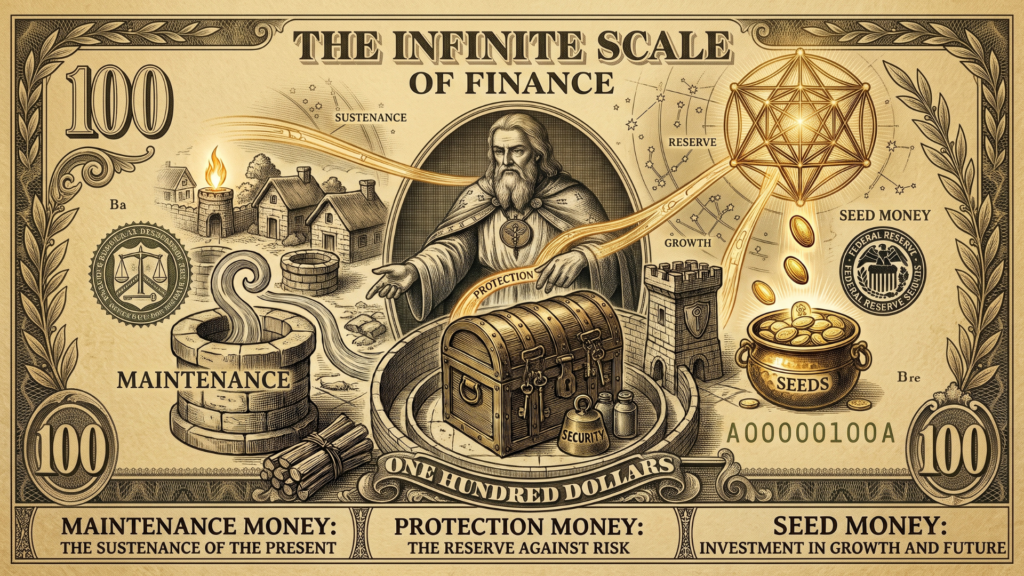
Once this distinction becomes clear, saving begins to acquire a broader meaning. Instead of asking only, “How much money did I manage not to spend?”, a more constructive question becomes: “How much of what I received did I intentionally preserve for something that has not yet been created?” That is the beginning of what we are calling Seed Capital. The term itself is a financial metaphor rather than a teaching found directly in The Kybalion, but the analogy reflects the book’s broader description of Gender as a principle associated with generation and creation.
Seed Money: When Saving Changes Its Purpose
There is a subtle but important difference between saying, “This is the money I had left over,” and saying, “This is capital I am intentionally preserving for my future.” The amount may be exactly the same, but its function is no longer the same. “Leftover money” sounds accidental. It is simply whatever remains after everything else has already happened. Seed Capital, by contrast, is intentional. It has been separated because it has been given a purpose, even if that purpose is not yet completely defined. This does not mean that you need to immediately place that money into a complex investment or begin studying financial markets. The first step can be much simpler: creating a category of money that belongs neither entirely to present consumption nor exclusively to emergency protection. It is reserved for future construction.
Imagine a farmer after the harvest. If every grain is consumed, there may be enough food for the present, but nothing remains for the next planting season. The wise farmer understands that part of the harvest must be preserved because it serves a different function. It is not being withheld without purpose; it is being protected because it carries the possibility of future generation. Money can be approached through the same metaphor. The seed may initially be very small. It might be $5, $10, or a modest fixed percentage of your income. At this stage, the important point is not whether that amount will immediately transform your financial situation. What matters is that you have begun to consciously distinguish fruit from seed — what supports the present from what is being preserved to help create the future.
In the context of this article, “Seed Capital” is not a term taken directly from The Kybalion. Rather, it is a practical metaphor inspired by the broader Hermetic idea that generation requires something to be preserved, directed, and allowed to participate in a process of creation.
Cause and Effect: Give Your Money a New Function
Another Hermetic principle helps us understand this shift more clearly: the Principle of Cause and Effect. The Kybalion teaches that every cause has its effect and every effect has its cause, and that events do not arise without conditions that contribute to their appearance. Applied carefully as an analogy to financial behavior, this principle invites us to observe the patterns we repeatedly create and the kinds of results those patterns tend to produce.
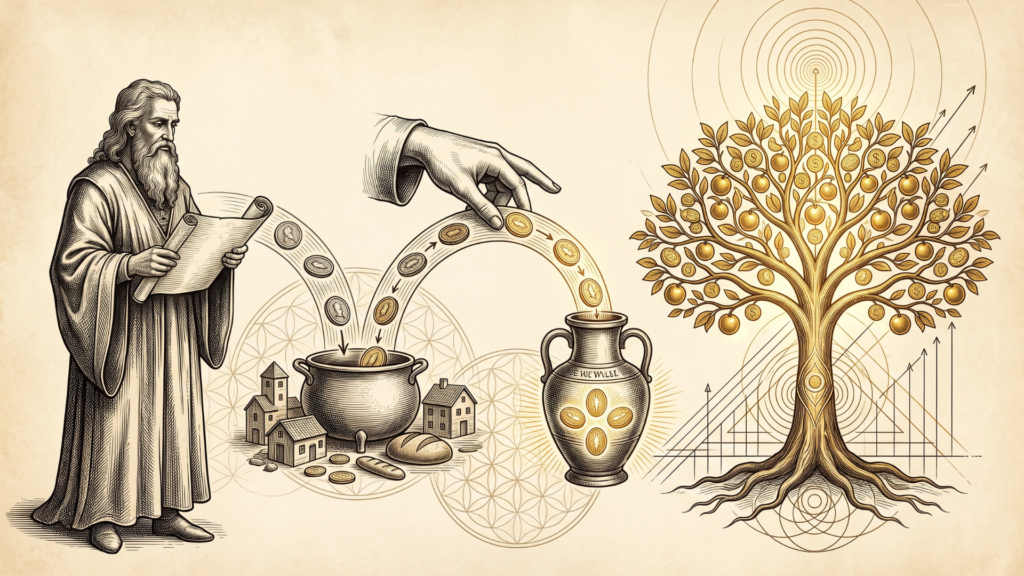
Suppose nearly every month follows the same general structure: income arrives, bills are paid, consumption continues, and the balance eventually returns to zero. If that pattern remains largely unchanged, it is reasonable to expect similar financial outcomes to continue appearing. There is no spiritual punishment involved here, nor is every financial result caused by personal behavior alone. External circumstances also matter. The point is simply that repeated structures often help reproduce repeated outcomes. Now imagine that even a very small portion of that income begins to follow a different path. Part of it is preserved, that preserved amount becomes what we are calling Seed Capital, and over time it begins to represent possibilities that did not exist before. Perhaps only $10 moved differently this month. In purely numerical terms, that may seem insignificant, but in terms of structure, something important has changed: that money has been assigned a new function.
This leads to one of the central ideas of this article and blog until now: the first multiplication is not necessarily in quantity, but in function. Before $10 can ever become part of a larger financial structure, an earlier transformation must occur. Those $10 must first stop being treated exclusively as money available for immediate consumption and begin to be regarded as a resource with a future purpose. This is the foundation upon which larger financial structures may eventually be built. Before capital can grow, some form of capital must first be preserved. And before meaningful amounts can accumulate, we must first develop the habit of not consuming everything that could otherwise become part of that foundation.
The Principle of Rhythm: A Seed Needs Time
There is one more lesson we need to understand before the metaphor of Seed Capital becomes complete. A seed cannot be planted in the morning and become a mature tree by nightfall. Between planting and harvest, there is an element we cannot eliminate: time. This is where the Hermetic Principle of Rhythm offers another useful philosophical parallel. In The Kybalion, Rhythm refers to the movements, oscillations, tides, and recurring cycles that can be observed throughout manifested existence. Everything moves through processes of advance and return, rise and fall, activity and rest. Applied carefully as an analogy to financial behavior, this principle reminds us that meaningful change is often built through repeated cycles rather than through one dramatic moment.
“Everything flows, out and in; everything has its tides; all things rise and fall; the pendulum-swing manifests in everything.” — The Kybalion, Principle of Rhythm
Income arrives, resources are distributed, a portion is preserved, and eventually the process begins again. What appears insignificant during a single month can take on a very different meaning when the same deliberate action is repeated over longer periods. This is why, especially in the beginning, consistency can be more important than intensity. It is also why the desire for rapid wealth can become dangerous. Anxiety tries to eliminate the space between planting and harvesting. We want the seed today and the tree tomorrow, which can make promises of extraordinary returns and instant transformation especially attractive. Symbolically, they offer the fantasy of a harvest without allowing for a season of cultivation.
Sustainable financial development usually requires something less dramatic but far more reliable: repetition, knowledge, patience, discipline, and time. Even the mathematical concept of compound growth can help illustrate this idea, without implying that every investment will necessarily grow or produce a particular return. Under appropriate conditions, small amounts accumulated and allowed to grow over long periods can eventually produce results that are difficult to perceive at the beginning. This is why the metaphor of multiplication requires both a seed and a season. Time alone cannot produce a harvest if nothing has been planted, but planting alone is also insufficient if the process is constantly interrupted before it has an opportunity to develop.
Practice: Create Your First Seed Capital
The practical part of this article can remain simple. You do not need a complicated spreadsheet or a detailed investment strategy to begin. Take a piece of paper, open a note on your phone, or simply sit somewhere quiet for a few minutes and look at the resources that normally enter your life each month. Begin by thinking about those resources according to three different functions:
- The first is Maintenance, which includes the money required to sustain your present life: housing, food, transportation, bills, necessary expenses, and the forms of leisure you consciously choose to maintain.
- The second is Protection, which is the portion reserved to create greater stability and reduce the likelihood that an unexpected expense immediately becomes new debt.
- The third is Seed Capital, a separate amount deliberately preserved and creation of your future.

These categories should follow a sensible order. Essential needs and immediate obligations come first, and creating a basic layer of financial protection may be more urgent than building Seed Capital. The purpose of this practice is not to ignore present responsibilities in pursuit of a future ideal, but to gradually create room for a new financial function when your circumstances allow it. There is no need to force a rigid percentage. If 10% is realistic after your essential responsibilities are covered, you may begin there. If that is too much, choose 5%, 1%, or even a small fixed amount. The goal is not to create financial discomfort in the name of discipline. The goal is to establish a category that may not have existed before and to begin cultivating the habit of preserving something intentionally for the future.
Once you decide on that amount, stop referring to it merely as “what was left over.” Give it a name. You can call it Seed Capital, Future Capital, or even Capital of Sovereignty if that language resonates with you. The important thing is that the name reminds you that this resource has been assigned a different purpose. It is no longer simply money waiting for its next opportunity to be consumed. When you separate it, take a brief moment to reinforce the intention behind the action and say: “I receive with awareness, preserve with wisdom, and plant with purpose. Not every resource that reaches my hands is meant to be consumed.”
After that, allow the seed to remain preserved. You do not need to determine its ultimate destination immediately. For now, the practice is simply to create the seed, protect it from unnecessary consumption, and repeat the process whenever new resources arrive. Over time, what begins as a small financial distinction can become the foundation for more deliberate decisions about what that capital may eventually be used to build.
From Preservation to Purpose
At a certain point, or for some person, investing stops being only about “making money grow” and begins to become something more personal: deciding what that growth is meant to serve. This is where financial planning can take on a deeper meaning, because capital is not valuable only for the number it may become in the future, but for the possibilities that number can eventually create.
For one person, the purpose may be to build greater security for a spouse, children, or grandchildren. For another, it may be to create enough stability to enjoy later years with more freedom and less dependence. Someone else may want to use future returns to support a charitable organization, contribute to a cause they believe in, help a family member, fund a meaningful project, or create something that continues beyond their own lifetime. The destination does not need to be the same for everyone, because the meaning of abundance is deeply connected to what each person values.
Seen this way, investing does not have to feel like a race, a competition, or an activity reserved for people obsessed with financial markets. It can simply become a way of giving part of today’s resources a longer life. Money that is carefully preserved and responsibly placed to grow may one day help pay for an education, support a loved one during a difficult period, finance a new creation, strengthen a community, or become part of the legacy someone chooses to leave behind.
This perspective can be especially important later in life. Beginning to invest does not necessarily mean chasing aggressive returns or trying to recover “lost time.” It can mean choosing, with prudence, what you would like the resources you have already built to accomplish from this point forward. The objective may be growth, preservation, income, inheritance, generosity, or simply greater peace of mind. What matters is that the decision reflects your reality and your purpose. Perhaps this is the deeper meaning of Seed Capital. A seed is not valuable merely because it can become larger. Its value lies in what it may eventually nourish, protect, or bring into existence. In the same way, the purpose of financial multiplication does not need to end with accumulation. Growth can become family security, independence, generosity, opportunity, creation, or contribution.
So when you think about the resources you choose to preserve and eventually invest, it may be useful to ask a different question. Not only, “How much could this become?” but also: “What would I like this money to make possible?”