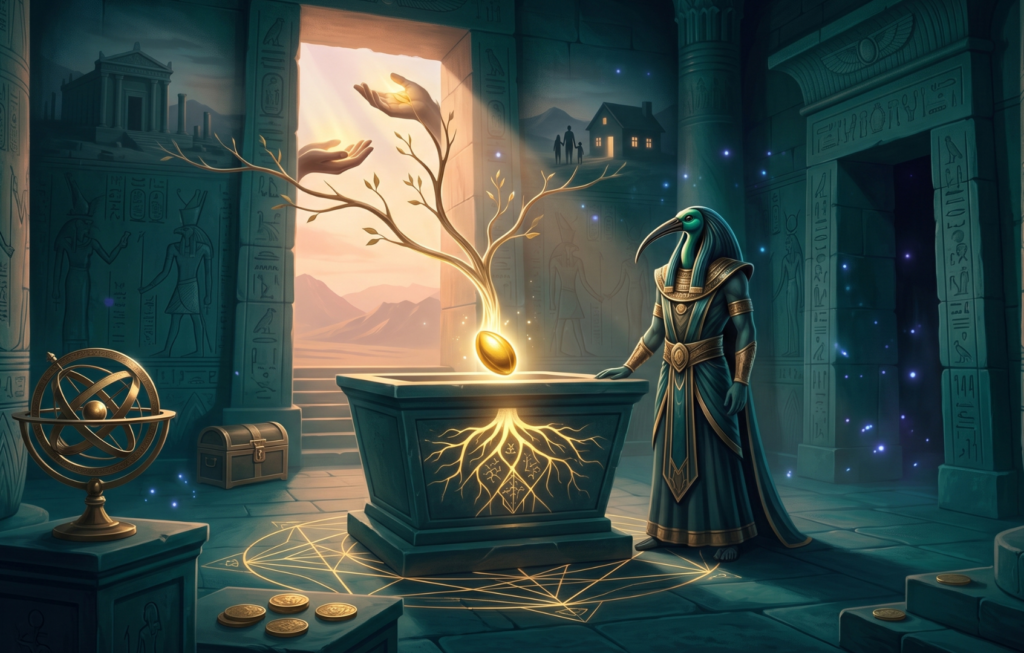
In Ancient Greece, those who arrived at the sanctuary of Apollo at Delphi encountered more than a famous oracular center. The temple was also associated with brief maxims that became part of the Greek philosophical tradition. Among them was “Know thyself” — gnōthi seauton. Plato, Pausanias, and later Plutarch recorded the connection between this maxim, Delphi, and the tradition of the Seven Sages.
The phrase did not originate in Hermeticism. Even so, the question it raises has a deep affinity with certain Hermetic texts: what does it really mean to know yourself?
Centuries later, the treatises gathered in the Corpus Hermeticum would explore knowledge of the human being in relation to mind, cosmos, and the divine. In the first treatise, Poimandres, Hermes seeks to know “the things that are,” understand their nature, and know God. The investigation of the human being appears within a religious and cosmological vision far broader than what we would now call personality analysis.
This historical difference is important. But it does not prevent a contemporary reflection. If knowing yourself requires investigating what you are, an inevitable question arises: who are we when we stop defining ourselves exclusively by our habits, our fears, our past, and the roles we perform?
When What We Do Begins to Look Like Who We Are

Throughout life, we build an identity from experiences, relationships, choices, and circumstances. The problem begins when we stop noticing the difference between one part of our story and the totality of who we are.
A person may spend decades in a particular profession until they answer the question “who am I?” almost exclusively with the name of their job. Another may carry an old failure for so long that they stop thinking “I failed in that situation” and begin concluding “I am a failure.” The same can happen with fear: after years of avoiding certain experiences, someone may stop recognizing fear as a response and incorporate it into their identity — “I am just this way.”
These experiences are real. They leave marks and influence future decisions. Self-knowledge, however, does not require concluding that everything that was learned, repeated, or feared must continue defining all of a person’s possibilities.
There is a difference between identity, conditioning, and consciousness. Our identity brings together the stories and characteristics through which we recognize ourselves. Conditioning involves patterns acquired and reinforced through repetition. Habits turn certain responses into familiar behaviors. Consciousness, in turn, makes it possible to observe these structures, even when we are deeply identified with them.
This does not mean that there is a “pure” and perfect personality hidden beneath all experience. It simply means that being influenced by a history is not exactly the same as being reduced to it.
Perhaps an important part of self-knowledge lies precisely in asking: how much of what I call “me” is a present choice, and how much is something I learned to repeat?
Self-Knowledge in the Corpus Hermeticum

In ancient Hermeticism, this investigation takes on a more spiritual than psychological dimension. The aim of the treatises is not to teach a modern technique for building self-esteem or replacing “limiting beliefs.” Self-knowledge appears in relation to recognizing the human condition, the nature of mind, and above all, the relationship between the human being and the divine.
In Poimandres, the question of human nature is embedded in a revelation narrative about God, the cosmos, and human origins. To know does not mean merely gathering information about one’s personality; it means transforming the way one understands one’s own existence.
This dimension becomes even more explicit in Corpus Hermeticum XIII, a dialogue between Hermes Trismegistus and his disciple Tat about spiritual rebirth. Tat seeks to understand a form of birth that is not simply physical, and Hermes describes a transformation connected to the knowledge of God and to a new form of perception. The passage presents twelve “torments,” including ignorance, disordered desire, greed, envy, anger, and malice.
It would be easy to translate this list into contemporary language and say that Hermes is simply teaching how to “eliminate negative habits.” But that would reduce the meaning of the treatise. The rebirth described in the text has a religious and spiritual character: it concerns a profound transformation of the human condition and perception before the divine.
Even so, there is a reflection that can be brought into the present without rewriting the past. If certain states can dominate our perception, it may be useful to observe how often we begin treating them as identity.
Feeling anger does not necessarily mean being an angry person by nature. Experiencing envy does not make envy someone’s complete definition. Feeling fear does not require accepting that every future decision must be organized around that fear.
The point is not to reject your own history, but to see it more clearly. Self-knowledge also means recognizing what we have learned to become and consciously examining what we still wish to continue being.
Knowing Yourself Does Not Mean Erasing Who You Were
When we return to Delphi, the ancient maxim takes on another layer of depth. “Know thyself” seems simple because it contains only a few words, but even in Antiquity it generated philosophical interpretations. Plutarch observed how many discussions had arisen from that inscription, as though such a short phrase had produced an extraordinary number of questions.
Perhaps it remains relevant precisely because it is easy to spend much of life without seriously examining what we call identity. We fulfill roles, develop habits, respond to other people’s expectations, and repeat behaviors that once served some purpose. Over time, all of this can begin to feel inseparable from who we are.
The Hermetic perspective adds a different dimension to the question of Delphi. In the ancient treatises, knowing is not merely cataloging personal characteristics, but transforming the way the human being understands their nature and their relationship with something greater than themselves.
For us, this tradition may offer a more modest, but still powerful, question: am I observing my patterns, or simply living as though all of them were inevitably “me”?
Let’s Take a 2-Minute Reflection
Choose a role or characteristic you often use to define yourself: “I am insecure,” “I am always the responsible one,” “I am my work,” “I cannot change,” or any other recurring definition.
Ask yourself:
- When did I begin to see myself this way?
- What experiences helped strengthen this definition?
- Is there any part of it that is still true, and any part that has simply become a habit?
- What small choice would I make today if I did not have to completely obey this identity?
The goal is not to erase the past, eliminate every fear, or abandon the roles we play. It is to recognize that our history participates in who we are without necessarily determining everything we can still become.
Centuries after Delphi, perhaps this remains one of the most difficult aspects of “Know thyself”: discovering not only what we have been conditioned to be, but also what we are still capable of consciously choosing.
To continue exploring Hermeticism, its texts, and its historical symbols, follow the other studies from Vibrational Portal and the exclusive content available in the Patreon community.
If you would like to continue following our journey through the Seven Hermetic Principles, explore the other studies available on the website, discover our e-books, and, for more in-depth content, also join our Patreon community.