Long before clocks, digital calendars, or weather forecasts, life in ancient Egypt depended on the ability to observe changes that returned year after year. The Nile would advance over the land and, some time later, recede, leaving behind the conditions necessary for cultivation. Agriculture, work, and the very organization of time had to follow these transformations, because each phase brought different needs with it.
Around 2450 BCE, the Egyptians were already using a civil calendar divided into three major seasons: Akhet, associated with the inundation; Peret, with the reemergence of the land and the cultivation period; and Shemu, with the harvest. Each occupied four months of the calendar. This division was not simply a way of counting the days. It helped organize life around a reality that repeated itself before them: not every moment calls for the same response.
It is important, however, not to confuse this Egyptian organization with the fifth principle presented in The Kybalion. The book was published only in 1908 and formulates, in its own way, the so-called Seven Hermetic Principles. Even so, the ancient Egyptian calendar offers us an especially useful image for entering the subject of this study, because it shows something that human experience has recognized for a very long time: life unfolds through cycles, alternations, and changes of phase.
In the previous article, we saw that Polarity allows us to understand certain states as degrees within the same relationship. But if there are different positions between certain poles, a new question arises: why do we not always remain at the same point? Why are there moments of expansion and contraction, enthusiasm and fatigue, movement and pause?
It is precisely at this point that we arrive at the Fifth Hermetic Principle presented by The Kybalion: Rhythm. And the question that will accompany us throughout this study is simple, but important:
If we cannot prevent every change of phase, how can we avoid being completely swept away by it?
What Does the Principle of Rhythm Really Teach?
The Kybalion presents Rhythm through one of the best-known images in the book:
Everything flows, out and in; everything has its tides; all things rise and fall.
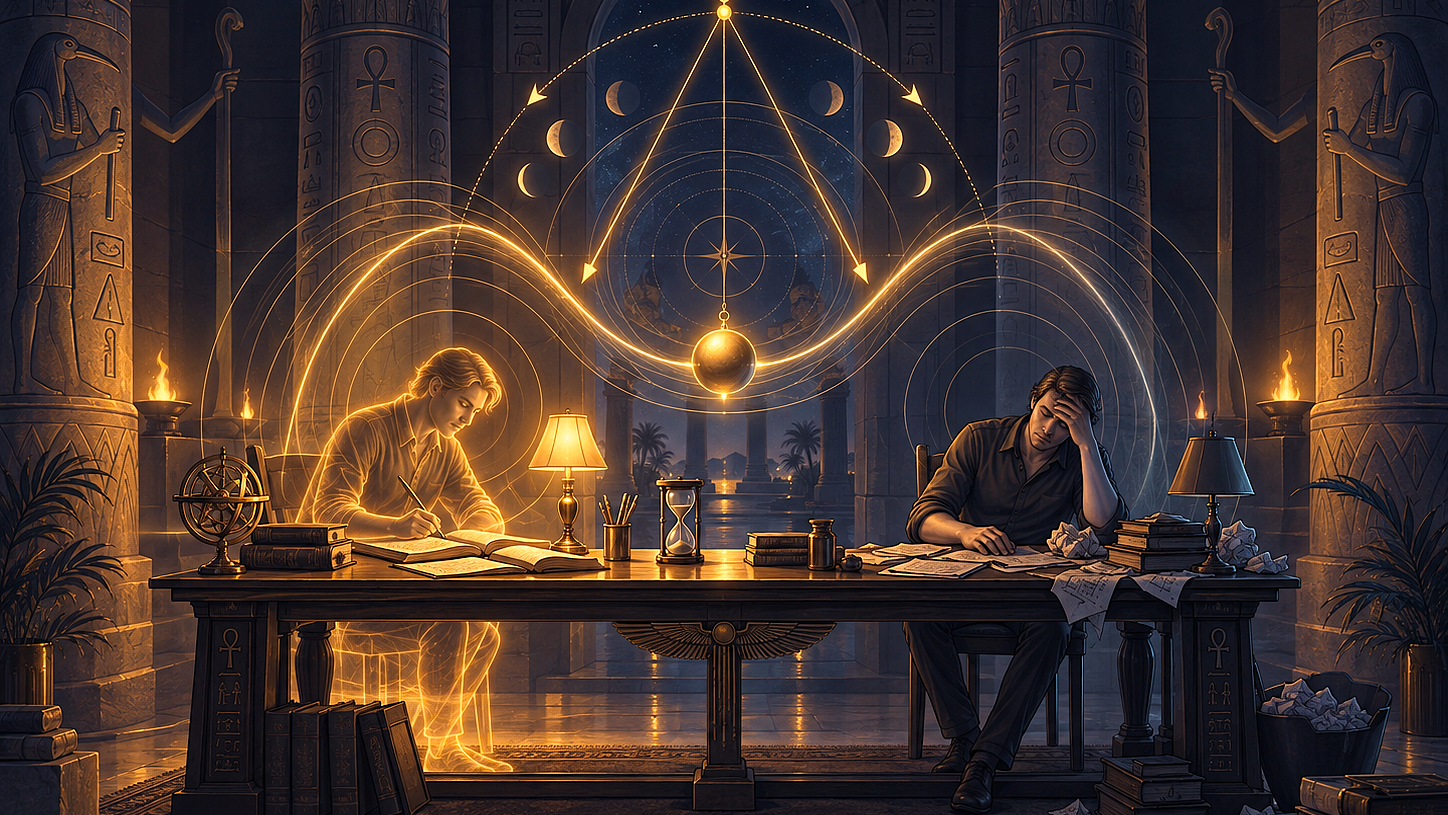
The text continues by comparing this movement to the swing of a pendulum. There is ebb and flow, advance and return, rise and fall. Within the philosophical system of the work, this oscillation appears on the physical, mental, and spiritual planes and is directly related to the previous principle, Polarity. The book states that Rhythm manifests between the poles established by Polarity, although the movement does not necessarily have to reach the absolute extremes.
This distinction is important. Rhythm does not simply mean that everything that rises must fall, nor that future events can be predicted because something similar happened in the past. The principle describes movement and alternation, not a perfect repetition of history.
We can easily observe this in nature. Day and night return, but no day is an exact copy of the one before it. The seasons repeat, but temperature, rainfall, and conditions vary. The tides advance and recede without producing exactly the same configuration every time.
For this reason, a more careful way of understanding the principle would be:
Rhythm speaks of alternation between phases, not of a perfect repetition of the past.
How the Pendulum Appears in Real Life
The image of the pendulum becomes especially interesting when we bring it into everyday situations.
Imagine someone starting a new project. During the first few weeks, there is enthusiasm, energy, and a sense of discovery. This person begins working longer hours, cuts back on rest, takes on new tasks, and believes that level of intensity will be permanent.
Some time later, the energy begins to decrease.
The work that once seemed easy requires more effort, creativity slows down, and motivation no longer appears spontaneously. At that point, a dangerous interpretation can arise: Maybe I have lost my purpose, or This was not meant for me.
But perhaps nothing so definitive has happened. Part of this change may simply reflect a new phase of the project. And part of it may have been intensified by the excess of the previous weeks.
This point is important because it prevents us from turning Rhythm into a mystical explanation for everything. Not every drop in energy happens because an invisible law of the universe decided to push the pendulum to the other side. Sometimes, we work too much, sleep too little, create impossible expectations, or build routines that could not be sustained for very long.
The principle can then serve as a question rather than a ready-made answer:
Am I going through a change of phase, or am I contributing to making this fluctuation greater?
The Mistake of Turning a Phase into an Identity
Perhaps one of the most difficult consequences of these fluctuations is our tendency to turn temporary states into permanent definitions.
I am unmotivated becomes I have no discipline.
I am tired becomes I cannot do this anymore.
I am insecure comes to mean I am not capable.
The problem lies in the leap between a current state and a conclusion about identity. We can truly be tired, insecure, or unmotivated without those conditions representing everything we are or everything we will be from this point forward.
A state can be real without being permanent.
This may be one of the most useful applications of Rhythm to personal development. Recognizing that movement exists does not mean denying what we feel. It means avoiding turning every fluctuation into a final sentence.
We also need to establish a clear limit. Depression, anxiety, trauma, and other physical or mental health issues should not be reduced to the image of a Hermetic pendulum. Philosophy can offer a language for reflection, but it does not replace professional evaluation or support when needed.
Neutralization: Can We Stop the Movement of the Pendulum?
The Kybalion presents, within the chapter on Rhythm, what it calls the Law of Neutralization. According to the text, the Hermetic practitioner does not eliminate the Principle of Rhythm; instead, they seek to reduce how much certain mental oscillations are able to carry them from one state to another. The book itself states that the principle continues to operate, even when the student seeks to escape part of its effects on consciousness.
The original language of The Kybalion involves concepts such as higher and lower planes of consciousness and the polarization of the mind. We do not need to turn these metaphysical claims into proven psychological facts in order to draw an interesting practical application from them.
Imagine that you wake up on a day when your motivation is low.
An automatic response might be: I do not feel like doing anything today, so I will do nothing. A more conscious response would be: My energy is lower today. I may not be able to maintain the same intensity, but I can still preserve what I consider essential. The internal state still exists, but it no longer has absolute control over the decision. In this sense, we can interpret neutralization in a practical way:
Neutralization does not have to mean stopping the pendulum. It can mean preventing every oscillation from automatically determining our direction.

Rhythm Is Not Resignation
There is another possible mistake: concluding that, if everything has phases, then we should simply accept any situation and passively wait for the next movement.
But recognizing cycles can produce exactly the opposite effect. It can help us prepare more realistic structures.
During periods of greater energy, for example, we can avoid taking on more commitments than we will be able to sustain. When motivation decreases, we can maintain a minimum version of the routine instead of abandoning it completely. During more favorable financial periods, we can prepare resources for future expenses. When creativity is high, we can take advantage of that moment without demanding the same level of performance from ourselves every day.
This also changes our relationship with rest. Resting consciously does not necessarily mean abandoning a path. In some situations, it is precisely what allows us to continue on it. Consistency, then, no longer means permanent maximum performance and start to mean preserving some continuity even when the level changes.
Returning to the Nile: Each Phase Calls for a Different Response
Now we can return to ancient Egypt.
Akhet, Peret, and Shemu represented different parts of the agricultural calendar: inundation, the emergence of the land, and harvest. These phases did not require the same activities. It would be absurd to expect to harvest throughout the entire year or to act during the inundation exactly as if it were harvest season.
The comparison interests us because it makes a simple idea visible: recognizing a phase can be more useful than demanding that it immediately become something else.
Perhaps, at certain moments, the most important question is not How do I get back to my peak?, but:
What phase am I in right now—and what does this phase actually ask of me?
There are moments of expansion and moments of consolidation. Periods when we need to move forward and others when we need to reorganize, recover, or simply preserve what has already been built. None of these phases needs to define the entire journey.
Practice: Map Your Rhythm
Set aside a few minutes and choose a single area of your life in which you notice some recurring fluctuation: work, motivation, creativity, money, study, or physical activity.
- Observe your high phase. How do you usually act when there is a lot of energy or enthusiasm? Do you make good use of that period, or do you tend to overdo it?
- Observe your low phase. What happens when your energy decreases? Do you consciously slow down, or do you completely abandon what you were doing?
- Look for the pattern. Ask yourself: Is there something I do when I am at my peak that makes the next phase more difficult? Perhaps it is overworking, lack of rest, expectations that are too high, or taking on too many commitments.
- Create two simple rules. For high periods, set a limit that helps prevent excess. For low periods, choose a minimum action that preserves continuity without demanding your maximum performance.
At the end, ask yourself one final question:
How can I respect the phase I am in without surrendering my entire direction to it?
The goal is not to predict the next movement. It is to better understand your own way of responding when the movement happens.
Learning to Move with Rhythm
The Principle of Rhythm does not need to be interpreted as fatalism. It does not offer us a formula for predicting markets, events, or every change in life. Within The Kybalion, it describes flow, ebb, and pendular movement; when applied carefully to everyday life, it can remind us that states and circumstances change and that we do not need to treat every phase as permanent.
Perhaps this is the point that reconnects our study with the ancient Egyptian calendar. The wisdom was not in demanding that the inundation behave like the harvest, but in recognizing that different moments called for different responses.
We do not control every tide. Even so, we can choose how we position ourselves when the waters change.
And this leads us directly to the next principle. If Rhythm shows us that there are movements we do not always control, Cause and Effect will ask us a new question: within those conditions, what causes can we still choose to set in motion?
Perhaps wisdom does not lie in stopping every tide, but in learning to preserve our direction when the waters begin to change.
If you would like to continue this journey through the Hermetic Principles, follow the upcoming studies published on our website. In the products section, you will also find our e-books and practical materials on Hermeticism, The Kybalion, Thoth, and personal development. For more in-depth studies, exclusive reflections, and complementary content, you can also become part of our Patreon community.