Since antiquity, different civilizations have preserved traditions of knowledge aimed at understanding the mind, nature, and the laws that govern existence. Among these traditions, few have exerted as much influence on esoteric philosophy as Hermeticism.
More than a set of beliefs, Hermeticism is a philosophical and spiritual tradition that proposes that the universe operates according to universal, immutable, and intelligible laws. Knowing these laws would be the path to understanding oneself, interpreting reality with greater depth, and developing a more conscious life.
Throughout the centuries, the teachings of Hermeticism have influenced initiatory schools, alchemists, philosophers, Renaissance scholars, occultists, and various modern currents linked to personal development, spirituality, and the so-called Law of Attraction. Many popular ideas about the power of thoughts, the unity between mind and reality, and the existence of universal patterns find inspiration, directly or indirectly, in Hermetic principles.
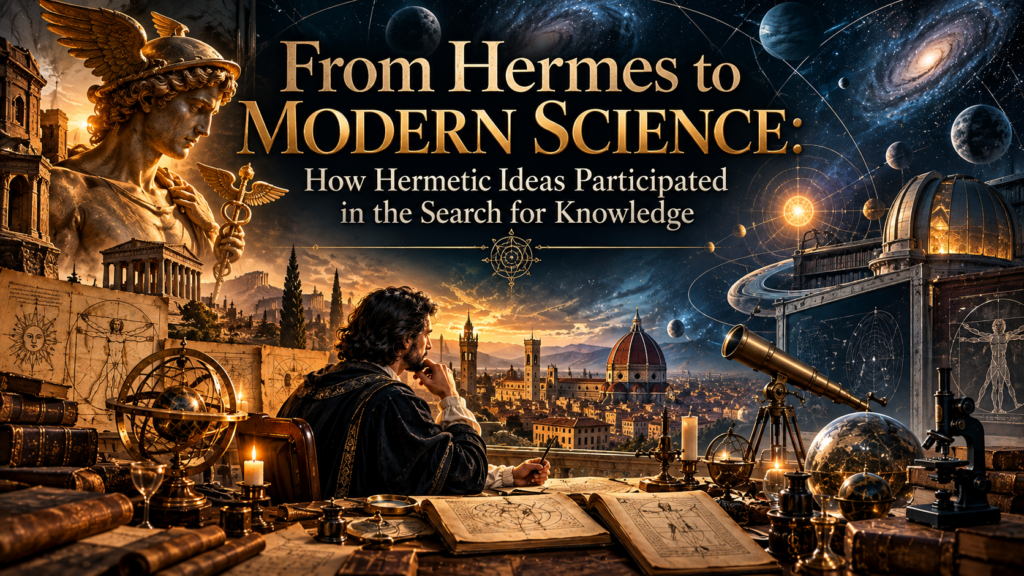
At the center of this tradition stands a figure shrouded in mystery and revered as the great source of Hermetic wisdom: Hermes Trismegistus. Regarded as the master who synthesized and transmitted the fundamental principles of Hermeticism, his name has become inseparable from this philosophy and from the teachings that, according to tradition, reveal the universal laws governing the mind, nature, and reality itself.
Who was Hermes Trismegistus?
There is no historical consensus that Hermes Trismegistus was a single person. Most researchers consider him to represent a symbolic or legendary figure created by the fusion of two major ancient traditions.At the heart of this tradition is a figure shrouded in mystery: Hermes Trismegistus, whose name means “Hermes the Thrice Great”.
The title “Three Times Great” It is interpreted in different ways within the tradition. The most widespread explanation is that Hermes mastered the three great sacred sciences of Antiquity: alchemy, astrology, and theurgy (or divine magic). Other interpretations claim that he was master of the three planes of existence—physical, mental, and spiritual—or that he combined in himself the qualities of king, priest, and sage.
Historically, the title is understood as an honorific epithet derived from the veneration of Thoth, exalting him as the greatest among the wise. In the Hermetic tradition, however, “Trismegistus” symbolizes the one who attained the highest understanding of the universal laws and became the great transmitter of the wisdom that inspired works such as the Corpus Hermeticum and, centuries later, The Kybalion.
On one side is Hermes, the Greek god associated with wisdom, writing, communication, and the transmission of knowledge. On the other is Thoth, the ancient Egyptian deity related to intelligence, mathematics, sacred writing, astronomy, magic, and the preservation of divine knowledge.
When Greeks and Egyptians began to share their cultures, especially during the Hellenistic period, these two figures were gradually identified as expressions of the same archetype: the great master of universal wisdom. From this union, Hermes Trismegistus was born.
In the Hermetic tradition, Hermes is presented not merely as a philosopher, but as an initiating master who is believed to have revealed fundamental principles about the nature of reality, consciousness, and the universe. Numerous ancient texts, later compiled into the Corpus Hermeticum, are traditionally attributed to him, although it is now understood that they were written by different authors between the 1st and 4th centuries AD.
Regardless of historical authorship, these writings have exerted an enormous influence on Western esoteric thought and continue to be studied by those seeking to understand the foundations of Hermetic philosophy.
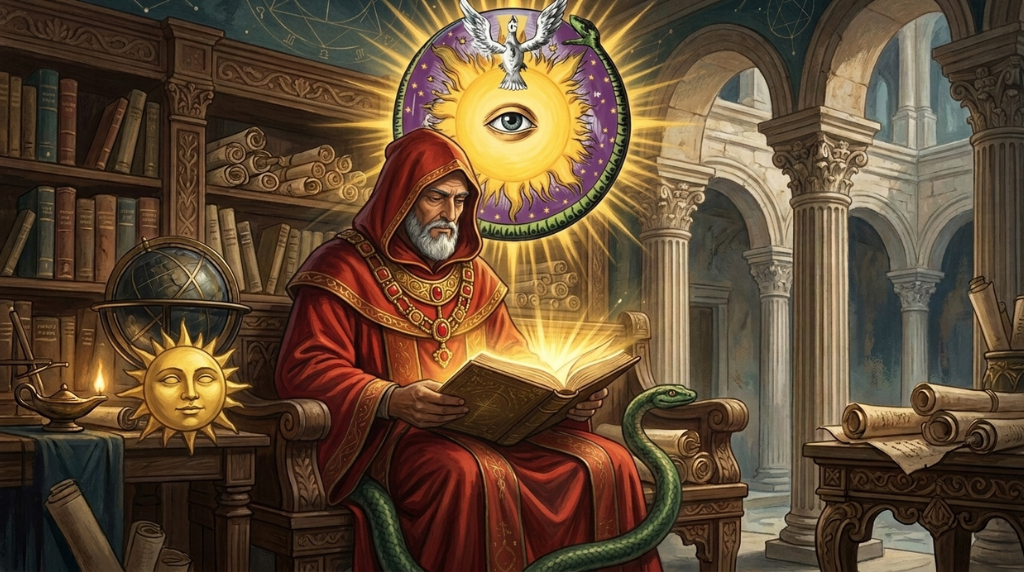
The relationship between Hermes Trismegistus and Thoth
For many esoteric traditions, Hermes Trismegistus and Thoth represent the same stream of wisdom expressed in different cultures.
Thoth held a central role in Egyptian cosmology. He was considered the patron of scribes, language, mathematics, sacred geometry, astronomy, medicine, and magic. He was described as the one who recorded the laws of the universe, maintained cosmic order, and transmitted knowledge to initiates.
When the Greeks came into contact with Egyptian culture, they noticed numerous similarities between Thoth and Hermes. Both were messengers of knowledge, intermediaries between the divine and the human, and guardians of wisdom.
For this reason, according to the tradition preserved in The Kybalion, Hermes Trismegistus was the great Father of Occult Philosophy and Alchemy. His wisdom was so vast that antiquity deified him in two forms: the Egyptians venerated him as the god Thoth, patron of writing and knowledge, while the Greeks associated him with the god Hermes, the messenger of divine truths.
Within the modern esoteric tradition, it is common to find references to the “Teachings of Thoth” and the “Hermetic Teachings” as parts of the same spiritual lineage. Although this identification is part of the Hermetic and occult tradition, it is not treated as a historical fact proven by academic research, but as a symbolic and spiritual interpretation widely disseminated in these circles.
The Kybalion and the systematization of the Hermetic Principles
Among the best-known modern works on Hermeticism is The Kybalion, published in 1908 by authors identified only as “The Three Initiates.”
The book is not part of the ancient Hermetic texts; rather, it presents an organized synthesis of Hermetic principles that reflect the essence of the tradition of Hermes Trismegistus. It presents seven fundamental principles that explain the workings of reality at all levels of existence: physical, mental, and spiritual.
These principles are:
- Mentalism;
- Correspondence;
- Vibration;
- Polarity;
- Rhythm;
- Cause and Effect;
- Gender.
Over time, these teachings have also been explored by various works dedicated to Hermeticism, philosophical alchemy, and initiatory traditions, becoming one of the best-known foundations of contemporary Hermetic philosophy. But today we will only address the first Hermetic principle: mentalism!
The First Hermetic Principle: Mentalism
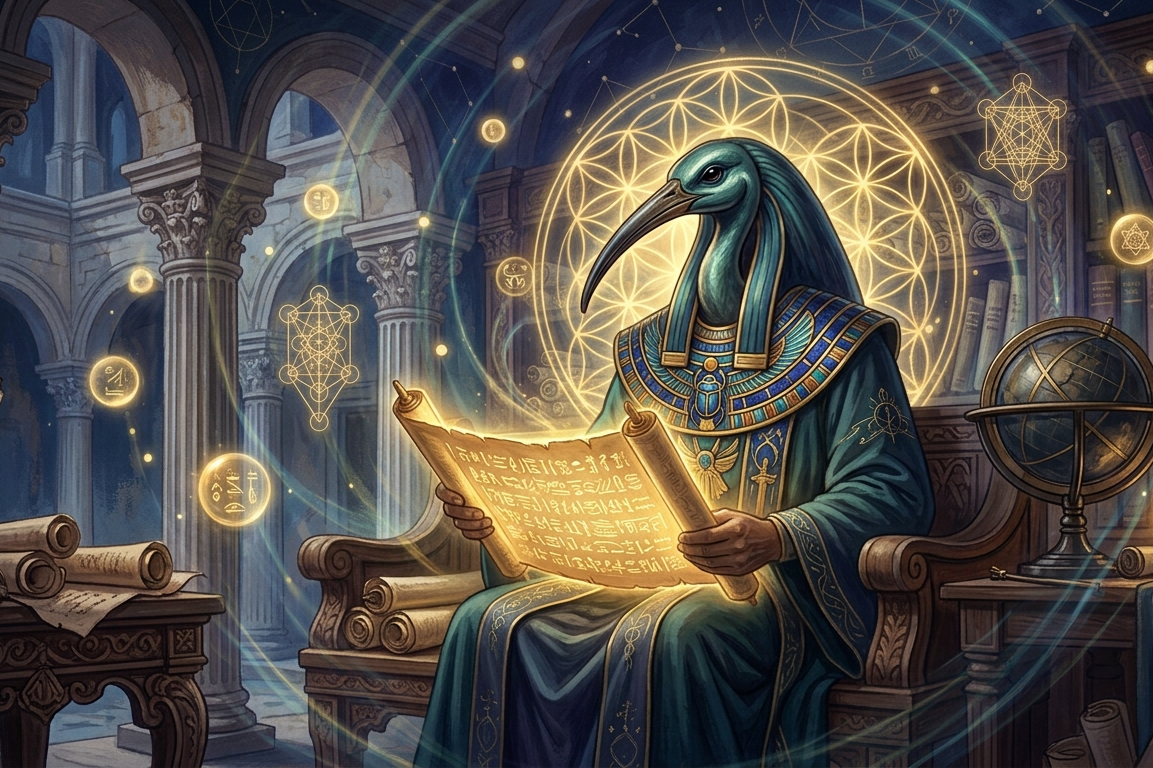
The first, and perhaps the best-known, principle is Mentalism. Its classic formulation in The Kybalion states:
“The All is Mind; the Universe is Mental.” – The Kybalion
This phrase summarizes one of the central ideas of Hermeticism: before any physical manifestation, there exists a reality of a mental nature. It explains that we must shape our minds before we even attempt to shape anything else in the universe.
According to this perspective, everything we perceive as matter, energy, forms, and phenomena originates from a Universal Intelligence—symbolically called “The All.” Where “The All” is also spirit, it is also part of us, and we are also part of it. The universe would therefore be a manifestation of this Universal Mind.
On a human level, this principle also emphasizes the importance of the mind as an instrument for perceiving, interpreting, and creating experience. Thoughts influence emotions, decisions, behaviors, and how each person responds to life’s circumstances. The mind selects thoughts, thoughts gain voice through speech, and speech, when exercised correctly, generates action that can transform reality through the power of Logos.
It is important to highlight that, in the Hermetic tradition, Mentalism does not mean that simply wishing for something will automatically make it happen. Instead, it proposes that the mind plays a fundamental role in how reality is understood and transformed, being only one of seven principles that work together.
For this reason, understanding Mentalism is considered only the first step. The other Hermetic principles deepen this vision by explaining how reality is organized through the correspondence between the planes of existence, vibrations, cycles, polarities, cause-and-effect relationships, and the interaction between complementary principles.
In the upcoming articles in this series, we will explore each of these principles in depth, beginning with Correspondence, one of the best-known ideas in the Hermetic tradition: “As above, so below; as below, so above.”
If you enjoyed this article and want to explore these ideas on a deeper level, I invite you to discover my e-book, The Logos Code. In it, I expand on the principles behind the power of the spoken word, conscious thought, and Hermetic philosophy, offering practical insights and exercises to help you apply these timeless teachings in your daily life with greater clarity and intention.
Are you ready to continue your journey? Simply click the link below to get your copy. By purchasing The Logos Code, you’re also directly supporting this blog and making it possible for us to continue researching, writing, and publishing in-depth articles like this one. Every purchase helps keep this project alive and allows us to continue sharing Hermetic wisdom with readers around the world. And because I want you to feel completely confident in your purchase, you’re protected by a 7-day money-back guarantee. If you decide it’s not the right fit for you, you can request a full refund within seven days.
Thank you for taking the time to read this article. I sincerely hope these Hermetic teachings inspire you to see yourself and the world from a new perspective. Your support truly means a great deal, and I look forward to seeing you in the next article.