In the mid-fifteenth century, Florence was experiencing an intense rediscovery of ancient texts. It was in this context that Marsilio Ficino, a philosopher and translator connected to the circle of Cosimo de’ Medici, was given the task of translating into Latin a collection of writings attributed to Hermes Trismegistus. These texts, which we now know as part of the Corpus Hermeticum, circulated widely during the Renaissance and helped renew interest in a view of the universe as an ordered, connected, and intelligible reality. Ficino worked on these translations in the 1460s, at a time when Platonic thought and other traditions from Antiquity were gaining new space in European culture.
Today we know something Renaissance readers did not: the Hermetic treatises were not written by an Egyptian sage from the most remote times. Historical research places them mainly in the first centuries of the Common Era, in a Greco-Egyptian environment marked by the blending of philosophy, religion, and spiritual practices. In the early seventeenth century, Isaac Casaubon helped dismantle the idea that these texts dated back to the time of Moses or to an extremely remote Egyptian antiquity, profoundly altering the historical authority that had been attributed to them.
Even so, the importance of Hermeticism during the Renaissance does not disappear because of this. The more interesting point is another: why did those texts find such fertile ground precisely at a time when the way nature was investigated was beginning to undergo profound transformation?
The answer requires care. Hermeticism did not create modern science, did not invent the scientific method, and did not secretly contain contemporary physics. But it participated in an intellectual environment in which philosophy, religion, medicine, astronomy, astrology, alchemy, and the study of nature were not yet separated as they are today. It is within this space of interaction that its history becomes especially interesting.
A Universe That Seemed to Hide an Order
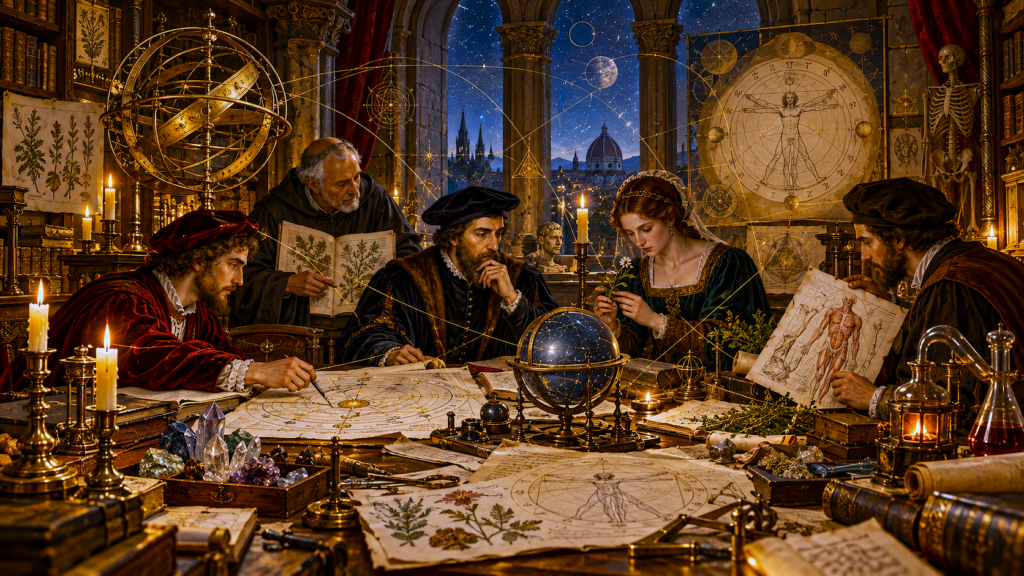
For many Renaissance readers, the universe was not seen as a collection of independent objects. It formed a structured whole in which different parts of reality could maintain relationships with one another.
Hermetic texts spoke of the cosmos, mind, correspondence, transformation, and the place of the human being within a larger order. This is not equivalent to what we today call scientific investigation, but it contributed to an important attitude: the conviction that nature possessed structure and that this structure could, in some way, be understood.
A scholar of the fifteenth or sixteenth century did not need to choose between being a philosopher, physician, astrologer, or investigator of nature in the way we imagine today. He could observe the heavens, study plants, reflect on the soul, work with minerals, and consider correspondences between the human body and the cosmos as parts of the same search.
This mixture may seem strange to us because we have inherited much more rigid disciplinary boundaries. At that time, however, these divisions were still being formed.
That is why the historical value of Hermeticism should not be sought in a list of “Hermetic scientific discoveries.” Its importance lies more in the fact that it participated in a culture undergoing transformation, in which nature was seen as something containing relationships, forces, and structures worthy of investigation.
We can summarize the idea this way:
Hermeticism did not provide the scientific method, but it participated in a culture increasingly interested in discovering hidden structures in nature.
Alchemy: Understanding Matter by Transforming It
Perhaps no field better reveals the meeting between philosophical reflection and material investigation than alchemy. Far from being limited to the attempt to transform lead into gold, it involved practices such as heating, distillation, dissolution, and calcination, as well as the observation of transformations in matter. These practices contributed to a tradition that, throughout the sixteenth and seventeenth centuries, underwent profound transformations into what came to be called chymistry.
This does not mean that alchemy simply “became chemistry.” Modern chemistry emerged from broader changes in theories of matter, experimental methods, measurement, and standards of demonstration. Even so, techniques and material practices developed in alchemical environments remained relevant.
This is precisely where alchemy becomes important to this discussion: understanding nature could also mean acting upon it, transforming matter, and observing its responses.
Alchemy and Hermeticism were also not synonymous, although they circulated in closely related environments and shared certain interests. At that time, the question of what existed behind appearances was beginning to be explored not only through texts and speculation, but also through furnaces, flasks, metals, and experimentation.
When the Boundaries Began to Change
Between the sixteenth and seventeenth centuries, Europe did not simply move from “superstition” to science. The transformation was gradual: astronomy and astrology began to separate, alchemy was reformulated, and observation, experimentation, calculation, and demonstration gained increasing importance, without older conceptions disappearing immediately.
One milestone in this change came in 1614, when Isaac Casaubon analyzed the texts attributed to Hermes Trismegistus and demonstrated, through linguistic and historical evidence, that they belonged to the first centuries of the Common Era, rather than to an extremely remote Egyptian antiquity.
This weakened an important part of their authority: the supposed antiquity of Hermes. From that point on, the texts had to be considered not only through their tradition, but also through the evidence supporting their origin and their claims.
It was not only the answers that were changing; what counted as a good reason to believe an answer was changing as well.
Newton: Science, Alchemy, and Theology in the Same Mind

Between the sixteenth and seventeenth centuries, Europe did not simply move from “superstition” to science. The transformation was gradual: astronomy and astrology began to separate, alchemy was
was being reformulated, and observation, experimentation, calculation, and demonstration were gaining increasing importance, without older conceptions disappearing immediately.
One milestone in this change came in 1614, when Isaac Casaubon analyzed the texts attributed to Hermes Trismegistus and demonstrated, through linguistic and historical evidence, that they belonged to the first centuries of the Common Era, rather than to an extremely remote Egyptian antiquity.
This weakened an important part of their authority: the supposed antiquity of Hermes. From that point on, the texts had to be considered not only through their tradition, but also through the evidence supporting their origin and their claims.
It was not only the answers that were changing; what counted as a good reason to believe an answer was changing as well.
From Hermes to the Technological World
We can now return to fifteenth-century Florence. When Ficino translated the Corpus Hermeticum, ancient texts could still be seen as keys to understanding the order of the universe.
Modern science operates through very different paths: precise measurements, controlled experiments, testable models, reproducible results, and instruments that radically extend our senses. Telescopes, microscopes, and particle accelerators investigate aspects of reality that are inaccessible to direct observation.
This is not “modern Hermeticism.” That would confuse the continuity of human curiosity with continuity of method.
Even so, one question crosses these different worlds: what exists behind what we are able to observe?
Hermeticism sought answers through correspondences and metaphysics; alchemy, through the transformation of matter; modern science, through testing, measurement, and the possibility of correcting its own conclusions.
The question remained. What changed radically was the way of deciding what counts as knowledge.
Practice: From Mystery to Investigation
We can draw a simple practice from this history, without turning science into spirituality or spirituality into science.
Choose a question you consider mysterious and separate three things: what I know, what I believe, and what I still do not know. Then investigate the origin of the claim — an ancient text, a modern interpretation, a personal experience, or research — and ask what evidence could confirm or contradict it.
Finally, remain open to the possibility of changing your mind in light of new evidence.
Perhaps this is one of the most interesting bridges between ancient curiosity and modern investigation: curiosity without credulity and skepticism without closure.
The Search Changed, the Question Remained
Hermeticism did not invent modern science, nor is there a direct line connecting Hermes Trismegistus, Newton, and today’s laboratories.
Its importance lies elsewhere. For centuries, Hermetic ideas were part of a culture in which philosophy, alchemy, medicine, religion, and the investigation of nature were still intertwined. The search for correspondences, invisible forces, and transformations expressed an attempt to understand a reality that seemed to conceal something beyond the surface.
Over time, the criteria changed: the authority of ancient texts gave way to observation, mathematics, experimentation, and criticism.
Even so, the same question runs through these different worlds:
There is something here that we still do not understand — how can we discover what it is?
The methods have changed profoundly, but the desire to understand the hidden structure of reality remains.
If you would like to continue exploring the relationship between Hermeticism, the history of ideas, and the search for knowledge, follow the upcoming studies on our website. In the products section, you will also find our e-books on Hermeticism and ancient traditions, while more in-depth content and exclusive materials are available to our Patreon community..
If you would like to continue following our journey through the Seven Hermetic Principles, explore the other studies available on the website, discover our e-books, and, for more in-depth content, also join our Patreon community.