In 1600, English physician and natural philosopher William Gilbert published De Magnete, bringing together experiments with magnets, compasses, and small magnetized spheres called terrellae — “little Earths.” From these experiments, he argued that the Earth itself behaved like a large magnetic body.
Today we know that this field is not static: its poles move, its intensity varies, and its orientation has reversed many times throughout geological history. The image is suggestive: a system can have structure without remaining still. It can change, reorganize itself, and continue to exist.

This leads us to the central question:
Can these transformations of the Earth serve, at least symbolically, as a way to reflect on our own periods of instability, adaptation, and rebalancing?
The Earth Has a Field — but That Field Is in Motion

Much of the Earth’s magnetic field is generated by the movement of liquid iron and other conductive materials in the outer core. This process sustains the geodynamo, which is responsible for most of the field surrounding the planet.
Although we can represent the Earth as a large magnet, its field is complex and variable. The magnetic poles move, the field’s intensity changes, and records preserved in rocks show that its polarity has reversed many times. The last complete reversal occurred about 780,000 years ago, and these changes can unfold over long periods.
For this reason, the current variation in the field does not mean that a new reversal is about to occur. The point that interests us is another:
Stability is not the same as immobility.
This is where we can leave geophysics for a moment and enter the realm of philosophy.
Where Science Ends and Metaphor Begins
Before drawing any Hermetic parallel, we must distinguish between physical causation and symbolic interpretation.
There is no established scientific basis for claiming that shifts in Earth’s magnetic field, the movement of the magnetic poles, or a future geomagnetic reversal directly cause “spiritual awakenings,” the opening of chakras, an increase in “personal frequency,” or collective transformations in consciousness.
But a Hermetic reading does not necessarily require such a causal claim. Hermeticism has long approached nature as a realm of correspondences—a world in which patterns observed in the cosmos can become mirrors through which human beings contemplate patterns within themselves.
In this sense, the movement of the magnetic poles can be approached not as a force that mechanically alters consciousness, but as a symbol of reorientation, transition, and the shifting of an underlying order. A change in the Earth’s magnetic field does not have to control the human mind to become meaningful as an image of inner transformation.
The distinction is essential: science describes what the phenomenon does; symbolism explores what the phenomenon can mean. Confusing the two weakens both. Keeping them distinct allows the natural world to serve as a profound mirror for the Hermetic imagination without turning metaphor into unsupported scientific fact.
It is in this sense that the principles presented in The Kybalion — especially Correspondence, Polarity, and Rhythm — can enter the discussion.
Correspondence: Similar Patterns Do Not Mean the Same Causes
The Kybalion presents Correspondence through the formula “As above, so below; as below, so above,” proposing relationships between different planes. It is a philosophical idea, not a scientific law.
For this reason, a change in the Earth’s field need not be understood as something that mechanically causes a change in human consciousness. From a Hermetic perspective, however, the relationship can be contemplated through the principle of Correspondence: the macrocosm and the microcosm reflect related patterns of order, movement, transformation, and reorganization.
The Earth’s field may undergo:
variation → reorganization → new configuration
While the human being may experience:
instability → transformation → new equilibrium
The value of the correspondence is not merely that these sequences look similar, but that the same principles of transformation may be contemplated across different scales of existence.
In this sense, Earth’s changing magnetism can be approached as more than a metaphor: it becomes a reflection within the greater order of nature, inviting us to contemplate how change in the macrocosm may correspond to processes of change within the microcosm.
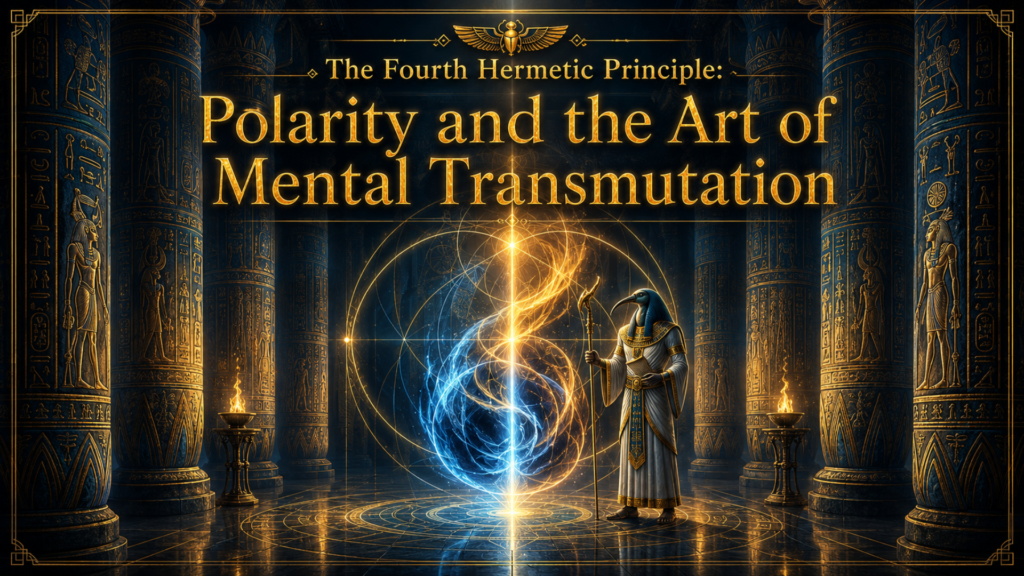
Polarity: Two Poles Do Not Mean Two Absolute States

The connection with Polarity seems more direct. The Earth’s magnetic field has opposite poles and, in simplified terms, exhibits dipolar behavior. In The Kybalion, however, Polarity means something different: the existence of poles and different degrees between them.
Magnetic polarity and Hermetic Polarity are not the same theory.
The value lies in the analogy. North and south do not represent “positive” and “negative” in a moral, spiritual, or emotional sense. The interesting point is that both belong to the same structure. Applied to inner life, this image allows us to think in terms of scales:
security ← intermediate degrees → uncertainty
expansion ← intermediate degrees → contraction
confidence ← intermediate degrees → doubt
Not every change happens from one extreme to the other. Much of experience takes place precisely within the intermediate degrees. And this leads us to Rhythm.
Rhythm: Change Does Not Mean Loss of Structure
The Kybalion describes the Principle of Rhythm through movements back and forth, ebb and flow, rise and fall. The book itself relates this movement to the poles established by the Principle of Polarity.
When we look again at the Earth’s magnetic field, we find a particularly useful image.
It varies. The poles move. The strength of the field changes. Its polarity has reversed many times. And yet we are still talking about a phenomenon that remains part of the Earth’s dynamics. This suggests a simple but important reflection:
Change and continuity do not need to be opposites.
In human experience, periods of instability often seem to indicate that something has “gone wrong.” A phase of doubt can feel like the permanent loss of certainty. A decline in enthusiasm can feel like the end of a project. A profound shift in perspective can feel like the loss of who we were. But perhaps some of these movements can be understood in another way.
certainty → doubt → reorganization
enthusiasm → reduced energy → adaptation
old structure → instability → new structure
This does not mean that every crisis is beneficial or that every change should be celebrated. It simply means that the presence of movement does not, by itself, prove that collapse is occurring. Sometimes what looks like disorder is part of a reorganization that is not yet complete.
Rebalancing Does Not Necessarily Mean Going Back
When the Earth’s magnetic field changes, there is no conscious attempt to restore some “perfect configuration” from the past. Its changes are part of the planet’s ongoing dynamics.
This image can be applied, carefully, to human experience. We often think of balance as a return: returning to our previous motivation, confidence, routine, or version of ourselves. But adaptation does not always mean rebuilding what existed before. Sometimes the process is:
instability → observation → adaptation → new organization
This new stability may take a different form. A career change, for example, may not restore the sense of security someone had in a previous job, but it may allow them to build a different kind of security based on new skills and experiences.
The same applies to changes in worldview: it is not always possible to return to old certainties. The next balance must incorporate what was learned.
The question stops being:
“How do I get back to where I was?”
and becomes:
“What kind of stability is possible from where I am now?”
A Planet in Motion

We return to William Gilbert.
In 1600, his experiments helped show that the Earth itself participated in the magnetic phenomenon. Over time, we discovered that this field is not motionless: it varies, its poles shift, and its orientation has reversed repeatedly.
Through Correspondence, we observe patterns without confusing them with causes. Through Polarity, we recognize the degrees between extremes. Through Rhythm, we see that movement and continuity can coexist.
In this way, the magnetic Earth stops being an explanation for our internal states and becomes a simpler image: a system that continues to reorganize itself while remaining in motion.
Continue exploring our articles on Correspondence, Polarity, and Rhythm on the blog, discover the Vibrational Portal e-books to deepen your studies, or follow our Patreon community to access new content and reflections.
If you would like to continue following our journey through the Seven Hermetic Principles, explore the other studies available on the website, discover our e-books, and, for more in-depth content, also join our Patreon community.