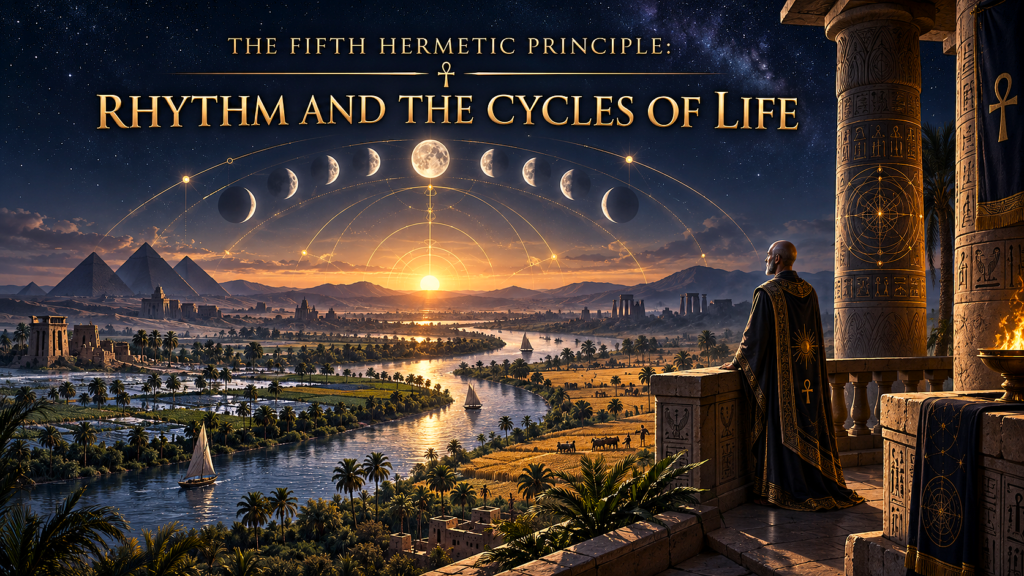
In 1656, Christiaan Huygens developed one of the first truly accurate pendulum clocks. Its operation depended precisely on the regular oscillation from side to side.
The movement was not a flaw to be eliminated, but part of the mechanism.
Centuries later, The Kybalion would use the same image to speak about something else: the oscillations of our mental and emotional states. Within the Principle of Rhythm, the book describes movements of advance and return, ebb and flow, applying this metaphor to changes in mood and internal states as well.
An apparent contradiction then arises: if the pendulum continues to move and Rhythm cannot be nullified, how can we speak of Neutralization?
The answer lies in understanding that neutralizing does not mean stopping the pendulum, but reducing how much we are carried by its movement.
Rhythm and the Mental Pendulum

Rhythm appears in The Kybalion as one of the Seven Principles and describes movements back and forth between different poles, including in mental states.
In practice, this image is easy to recognize. At times, we feel confident about a project; a few days later, the same idea may seem weak or unpromising. One week we are motivated; the next, the same task requires much more effort.
The Kybalion represents this alternation through the image of the pendulum. This does not mean that every emotional variation is literally caused by a “physical law of Rhythm,” but the metaphor can serve as a tool for self-observation.
The question, then, is:
how much does a change in our internal state need to change our direction as well?
This is where Neutralization comes in.
The Kybalion presents seven principles, and Neutralization does not appear as an independent eighth law. The so-called Law of Neutralization appears within the Principle of Rhythm as a method for reducing certain effects of pendulum-like movement on consciousness.
The distinction can be summarized as follows:
Rhythm = principle
Neutralization = method applied to the effects of Rhythm
The book itself states that Rhythm continues to operate. What the practitioner seeks to modify is the degree to which their consciousness is carried by that movement.
Within this logic, neutralizing does not mean destroying a law, but trying not to be carried away by all of its effects.
So, What Exactly Is Being Neutralized?
When explaining Neutralization, The Kybalion speaks of lower and higher planes of consciousness. The practitioner would seek to “rise” to a point where the pendulum continued to move, but without controlling their response.
In practical terms:
the state changes, but the response does not have to change with it.
Yesterday:
“This project has a lot of potential.”
Today:
“This project probably isn’t going to work.”
Before abandoning everything, ask:
did the facts change, or did only my state change?
Without Neutralization:
state → reaction
With greater awareness:
state → observation → choice → response
The oscillation continues. What decreases is its ability to make decisions for you automatically.
Neutralization is also connected to Polarity. In The Kybalion, Polarity describes the poles and the degrees between them; Rhythm, the oscillation between those positions; and the Art of Polarization, the attempt to reduce how much we are carried toward an undesirable extreme.
We can summarize it this way:
Polarity → where the poles are
Rhythm → how the oscillation occurs
Neutralization → how to avoid being carried automatically
For example:
confidence ↔ doubt
When doubt appears, there is no need to jump to absolute confidence. There are degrees between the extremes:
intense doubt → caution → stability → moderate confidence
This interpretation prevents Neutralization from becoming forced positive thinking. The goal is to find a position from which it is still possible to act with discernment.
Neutralizing Does Not Mean Repressing

This point requires care: Neutralization should not be confused with trying to eliminate unpleasant emotions.
Feeling discouraged does not require someone to abandon a project, but it also does not mean discouragement should be ignored. Feeling fear does not make every risk imaginary, just as it does not require immediate retreat. Enthusiasm can be positive, but it does not need to lead to impulsive commitments either.
A more careful application would be:
notice the state → recognize its presence → avoid the automatic reaction → choose the response
The difference becomes clear when we compare repression and Neutralization.
Repression says:
“I shouldn’t be feeling this.”
Neutralization, in this practical interpretation, would say:
“I am feeling this. But I need to decide whether this state should control my next action.”
For this reason, I would summarize the concept this way:
To neutralize is not to prevent the state from appearing; it is to prevent it from automatically taking control.
A Connection with the Corpus Hermeticum
The expression Law of Neutralization does not appear in this form in the Corpus Hermeticum, so we should not automatically project a concept from The Kybalion onto the ancient Hermetic texts.
Even so, there is a philosophical similarity. In Corpus Hermeticum XII, Hermes and Tat discuss the relationship between mind, impulses, and passions, exploring the difference between what governs and what is governed.
This does not mean that the text already taught the “Law of Neutralization.” The connection is simpler: both the Corpus Hermeticum and The Kybalion show a concern with the possibility that human beings do not remain entirely subject to their own impulses and internal states.
This is where the idea becomes practical.
Imagine someone building a study routine or developing a project. On Monday, they work for two hours with high motivation. On Wednesday, their enthusiasm decreases and they work for one hour. By Friday, the desire to give up appears.
Without a filter between state and action:
high motivation → progress
low motivation → abandonment
With greater observation:
high motivation → work
low motivation → less work, but continuity
The oscillation continues, but the direction is preserved.
In my view, this is one of the most useful applications of Neutralization: not every change in mood, energy, or perception needs to change your direction.
The Pendulum Does Not Need to Stop
We return to the image from the beginning.
A pendulum exists because it moves. In The Kybalion, Rhythm continues to operate even when the student seeks to reduce its effects on consciousness.
So perhaps the question is not:
“How do I stop the pendulum?”
But:
“How do I maintain my direction while it moves?”
Neutralization does not mean eliminating fear, doubt, or discouragement, but creating space between feeling an internal change and automatically obeying it.
This is where Rhythm and Neutralization meet: not in eliminating movement, but in preserving some stability within it.
Mastering the pendulum may mean maintaining your direction while it continues to move.
Continue exploring our articles on the Hermetic Principles on the blog, discover the Vibrational Portal e-books to deepen your studies, or join our Patreon community to find new content, guides, and practices.