In our previous study of the Seven Hermetic Principles, we explored the Principle of Mentalism, summarized in The Kybalion by the statement: “The All is Mind; the Universe is Mental.” This principle introduces one of the central ideas of modern Hermetic philosophy: behind the reality we perceive through the senses, there is a deeper mental principle from which manifestation and experience emerge. However, accepting this idea immediately leads us to another important question. If the universe is understood as mental in its fundamental nature, how does this Universal Mind organize itself and express its patterns through the different levels of existence?
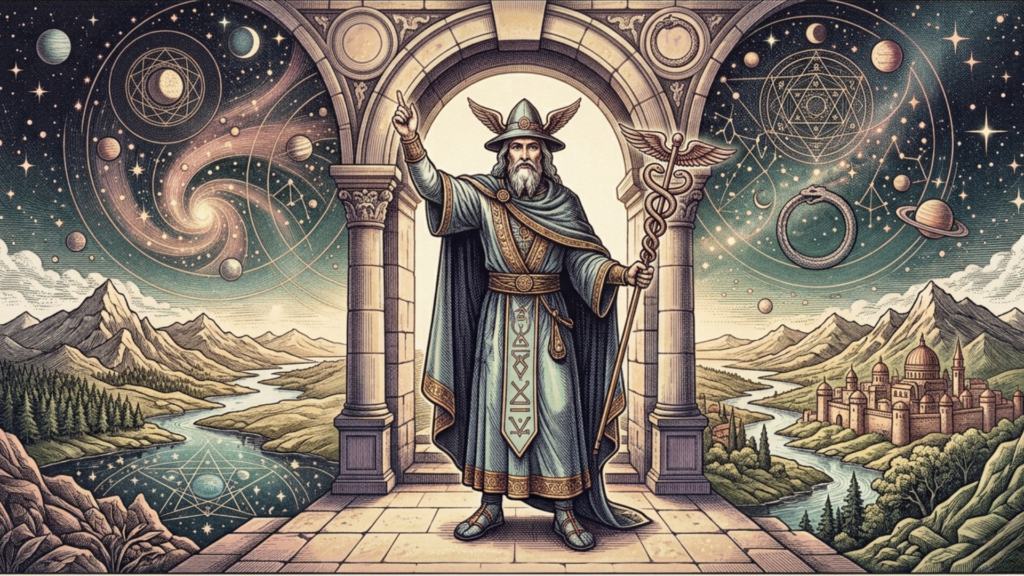
This question leads directly to the Second Hermetic Principle: the Principle of Correspondence. In The Kybalion, its essence is summarized by the famous maxim “As above, so below; as below, so above.” The idea behind this expression, however, is much older than The Kybalion itself and is closely associated with the Emerald Tablet, one of the most influential texts of the Hermetic tradition. In one of its best-known formulations, the Tablet declares: “That which is below is like that which is above, and that which is above is like that which is below, to accomplish the miracles of one thing.”
At first glance, this phrase may sound mysterious, but its central idea is surprisingly practical. The Principle of Correspondence suggests that different levels of reality can express analogous patterns, allowing us to use what is visible and accessible as a key for contemplating what is invisible or difficult to comprehend. The small can reveal something about the great, just as the observation of a greater structure can help us understand the smaller structures contained within it. It is from this relationship that one of the most fascinating concepts of Hermetic philosophy emerges: the relationship between microcosm and macrocosm.
What Is the Law of Correspondence?
According to the philosophical framework presented in The Kybalion, reality can be considered through three great divisions: the Physical Plane, the Mental Plane and the Spiritual Plane. These should not necessarily be imagined as three separate places existing one above another, but as different levels or modes through which reality can be experienced and understood.
The physical plane encompasses the world of matter, movement and phenomena accessible to our senses. The mental plane concerns thought, consciousness, ideas, emotions and the processes of the mind. The spiritual plane, within Hermetic philosophy, refers to levels of existence considered beyond ordinary physical and mental perception. Although these planes are different, the Principle of Correspondence proposes that relationships and analogous patterns can exist between them.
This distinction is essential because Correspondence does not mean identity. When Hermetic philosophy says “As above, so below,” it is not claiming that everything occurring on one plane must be literally reproduced on another. Rather, it suggests that similar principles, structures or relationships may express themselves differently according to the plane in which they appear.
We can think of this in terms of a pattern expressed through different forms. A melody, for example, can be played in different octaves and with different instruments while remaining recognizable as the same musical structure. Its physical expression changes, but a relationship remains beneath those differences. In a similar philosophical sense, the Hermetic student looks for recurring patterns behind apparently separate manifestations of reality.
This is why Correspondence was regarded as a kind of key to knowledge. When something cannot be examined directly, we can begin by studying what is accessible to us and asking whether the pattern discovered there provides a clue to something greater. The visible does not automatically prove the nature of the invisible, but it can become a symbolic and philosophical bridge toward its contemplation.
Nature as a Book of Correspondences
This way of thinking helps explain why ancient philosophical, mystical and alchemical traditions observed nature with such attention. The cycles of day and night, the changing seasons, the phases of the Moon, the birth and decay of living things, the transformation of substances and the movements of celestial bodies were not viewed merely as isolated phenomena. They were often contemplated as expressions of patterns that might also appear at other levels of existence.
Nature therefore became something like a great symbolic book. By studying cycles outside themselves, philosophers could reflect upon cycles within human life. By observing processes of transformation in matter, alchemists could construct metaphors for transformations of consciousness. By contemplating order in the heavens, thinkers searched for principles of order that might also exist within the human being.
It is important, however, not to confuse these philosophical analogies with modern scientific equivalence. The Principle of Correspondence does not require us to claim, for example, that the structure of an atom is literally a miniature solar system. Such comparisons have appeared frequently in popular spiritual literature, but modern physics describes atomic structure very differently. The Hermetic value of Correspondence lies not in forcing scientific phenomena to fit ancient symbolism, but in observing relationships, proportions, cycles and patterns that can help us think about different levels of experience.
This more careful interpretation brings us to the traditional idea of the human being as a microcosm.
Microcosm and Macrocosm: The Universe Reflected in the Human Being
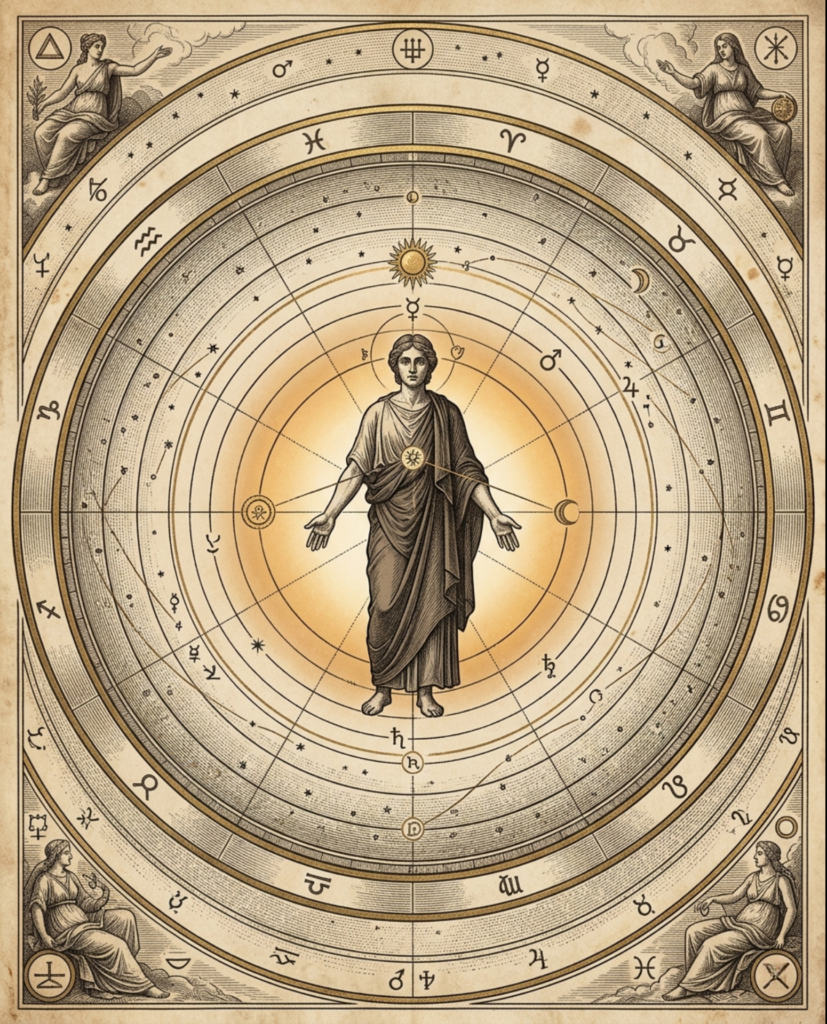
The relationship between microcosm and macrocosm is one of the most enduring themes in Western esoteric thought. The macrocosm represents the greater order of the cosmos, while the human being is contemplated as a microcosm—a smaller world containing, in symbolic or analogous form, principles that can also be observed in the greater whole.
This idea extends beyond The Kybalion and appears in different forms throughout ancient philosophy, Hermetic traditions, medieval and Renaissance thought, alchemy and other esoteric systems. Rather than viewing humanity as something completely separated from nature, these traditions often understood the individual as participating in the same greater order that governs the cosmos.
The relationship between microcosm and macrocosm is one of the most enduring themes in Western esoteric thought. The macrocosm represents the greater order of the cosmos, while the human being is contemplated as a microcosm—a smaller world containing, in symbolic or analogous form, principles that can also be observed in the greater whole.
This idea extends beyond The Kybalion and appears in different forms throughout ancient philosophy, Hermetic traditions, medieval and Renaissance thought, alchemy and other esoteric systems. Rather than viewing humanity as something completely separated from nature, these traditions often understood the individual as participating in the same greater order that governs the cosmos.
Consider how naturally this perspective arises from observation. Nature passes through periods of expansion and contraction, activity and rest, growth and decline. Human life also unfolds through cycles. Societies experience periods of construction and dissolution, while individuals experience psychological cycles of enthusiasm, exhaustion, renewal and transformation. The forms are not identical, yet the recurring presence of patterns encouraged philosophers to search for relationships between the greater world and the smaller world of human experience.
The human being, from this perspective, becomes more than an observer standing outside the universe. We become part of the phenomenon we are attempting to understand. By observing ourselves, we may discover clues about broader principles of organization, while observing the world around us may reveal patterns that help us understand ourselves.
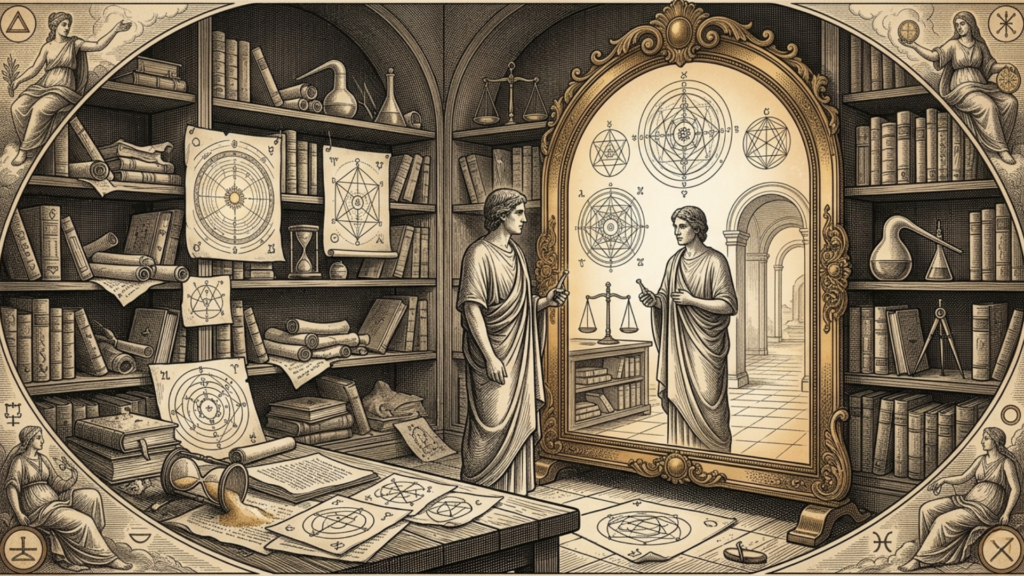
This is the deeper meaning of the mirrored universe. The mirror should not be understood as a perfect copy, but as a relationship in which one level can illuminate another.
The Inner Microcosm and the Outer World
The Principle of Correspondence becomes especially interesting when we stop treating it purely as a cosmological idea and begin applying it to everyday life. Our external circumstances are obviously influenced by many factors that have nothing to do with our individual thoughts: economic conditions, other people’s decisions, family circumstances, opportunities, accidents and countless events outside our control. For this reason, it would be simplistic to say that everything appearing in someone’s life is merely a direct projection of their mind.
Nevertheless, our internal patterns frequently influence how we interact with those circumstances. The way we think affects the decisions we make; our beliefs influence what we repeatedly avoid or pursue; our emotional patterns affect our communication; and our habits, repeated over months or years, can gradually produce visible consequences.
Someone who continually begins projects but abandons them halfway may eventually recognize a corresponding pattern of impatience, distraction or fear of failure. Someone who repeatedly avoids difficult conversations may discover that unresolved tensions appear across several different relationships. A person who constantly says that there is never enough time may eventually notice that their external schedule reflects an internal difficulty with priorities and boundaries.
The purpose of Correspondence is not to look at these situations and conclude, “My mind magically created everything that happened to me.” A more useful question would be: “What relationship exists between the pattern I am experiencing externally and the patterns I repeatedly cultivate internally?”
That small change in perspective makes the principle far more powerful. Instead of turning Correspondence into superstition or self-blame, we transform it into a method of self-observation.
Correspondence Does Not Mean Causality
This distinction deserves special attention because it is one of the easiest ways to misunderstand “As above, so below.” Correspondence does not necessarily mean that one phenomenon directly caused another. Two levels may reflect similar patterns without one being the exclusive cause of everything occurring in the other.
If someone experiences financial difficulty, illness, conflict or loss, it would be irresponsible to automatically conclude that the person created the event because of incorrect thoughts or a supposed “low vibration.” Life contains circumstances we control, circumstances we can influence and circumstances that simply happen around us. Hermetic philosophy becomes more useful when it encourages greater awareness of our sphere of influence without convincing us that we possess absolute control over every event.
At the same time, the relationship between inner and outer experience should not be ignored. An internal change can modify behavior, and changed behavior can gradually produce different external consequences. But the movement can also occur in the opposite direction. Organizing a chaotic environment can improve concentration. Changing a daily routine can influence emotional stability. Speaking differently can gradually alter the way we interpret ourselves and others.
This reciprocal movement is beautifully contained in the complete Hermetic maxim: “As above, so below; as below, so above.” The principle does not describe only a descent from mind into matter. It also suggests that experience in the material world can influence and educate the mind. The correspondence works in both directions.
The Mirror of Reality as a Hermetic Tool
Once we understand this, the Principle of Correspondence can become a practical diagnostic tool. Instead of attempting to analyze your entire life at once, choose one specific area—your finances, relationships, work, studies, home or creative projects—and observe which pattern appears there repeatedly.
Perhaps the recurring pattern is procrastination. Perhaps it is impulsiveness, disorder, fear of confrontation or difficulty maintaining boundaries. It could also be something constructive, such as discipline, patience, consistency or generosity. The important thing is not to judge the pattern immediately, but to recognize it clearly.
Then ask yourself where else that same pattern appears.
A person might discover, for example, that difficulty establishing boundaries appears simultaneously in relationships, professional life and finances. What previously looked like three completely separate problems can suddenly reveal a common structure underneath them. Instead of fighting each external symptom independently, the person can begin investigating the deeper pattern that connects them.
This is one of the most practical expressions of Correspondence: the visible provides information about the invisible, while the external pattern offers clues about the internal structure from which some of our repeated actions emerge.
However, recognizing a pattern does not transform it by itself. Awareness needs a bridge capable of carrying a new internal order into the world of action. Within our study, this is where another ancient and powerful concept becomes relevant: the Logos.
The Logos as a Bridge Between Thought and Matter
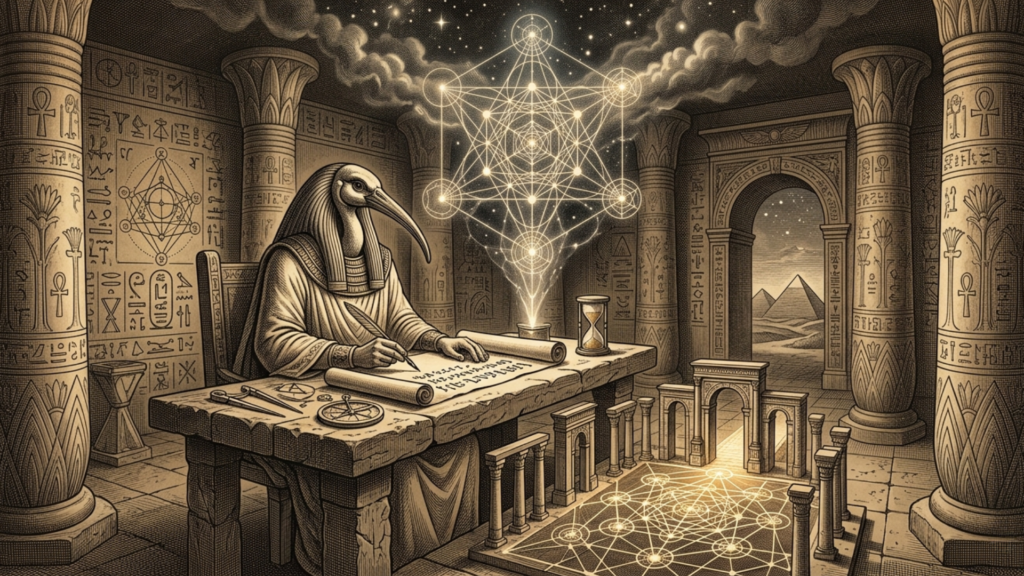
Before many human creations become physical realities, they first exist as ideas. A building exists as a conception and a plan before construction begins. A journey exists as an intention before the first step is taken. A promise exists as thought before it is expressed through language and confirmed through behavior.
Between the internal idea and the external action, language frequently plays an organizing role. This is one reason the concept of Logos has occupied such an important place in different philosophical and spiritual traditions. The term has carried several meanings throughout history—including word, discourse, reason and ordering principle—but for our practical study of Correspondence, we can focus on the way language gives structure to intention.
There is an enormous difference between vaguely thinking, “I need to organize my life someday,” and declaring with precision, “Tomorrow morning I will spend thirty minutes organizing my finances.” The second statement does not magically force reality to obey the speaker, but it gives an undefined mental intention a concrete structure. Thought has been translated into language, language can guide action, and action can finally produce a material consequence.
This is where Correspondence becomes movement rather than theory. What begins internally can acquire expression through the word and become anchored through action. At the same time, the consequences of our actions return to us as experience, influencing our future thoughts, beliefs and decisions. There is therefore a continuous relationship between inner consciousness and outer expression rather than a simple one-way process of “thinking something into existence.”
The Logos can be understood, in this context, as part of the bridge through which an internal order becomes communicable and actionable. And we explore the history and concepts of the Logos in much greater depth in our digital book, The Logos Code. You can find it, along with our other titles, in the products section of this website or by clicking on the e-book title within this text.
Why Changing Only the Reflection Often Fails
The metaphor of the mirror can help us understand why some attempts at personal transformation fail. Imagine standing before a mirror and wanting the reflection to display a different expression. Trying to alter the reflected image while keeping your own face exactly the same would obviously be impossible. You change the source, and the image changes with it.
Something similar can happen when we repeatedly try to change external circumstances without examining the behaviors and internal patterns that contribute to them. We may desire a different financial reality while continuing the same financial decisions, want healthier relationships while maintaining the same communication patterns, or seek professional transformation without developing new skills or changing our daily actions.
Yet the Hermetic maxim also reminds us not to make the opposite mistake. Because “as below, so above” suggests that changing the material side of our lives can also influence our internal state. Sometimes organizing the room helps organize the mind. Creating a schedule reduces mental confusion. Having the difficult conversation changes an emotional pattern that has persisted for years.
The strongest transformation therefore does not require us to choose between the inner and the outer. It asks us to bring them into greater correspondence. We cultivate clarity internally and create structures externally that support that clarity. One reinforces the other.
A Practical Exercise in Hermetic Correspondence
To experience this principle rather than merely understand it intellectually, choose one recurring situation in your life and describe it as objectively as possible. Avoid immediately labeling it as good or bad. Simply identify the pattern that continues to appear.
Then examine your inner world and ask which thought, habit, belief, fear or communication pattern might correspond with what you are observing. The goal is not to force yourself to find a hidden spiritual cause for every event, but to discover whether there is an internal element that you can actually influence.
Once you identify one, create a corresponding action in the physical world. If the internal pattern is fear of difficult conversations, the external action might be expressing one boundary calmly and clearly. If the pattern is the belief that you are incapable of managing money, the external action might be reviewing your expenses for the previous seven days. If the problem is constant mental distraction, the material correspondence might be removing one source of distraction from your workspace before beginning your next task.
Notice what has happened. You have not simply repeated an affirmation and waited for the external world to change. You have identified an internal pattern, given a new intention a clear form and created a physical action corresponding to it. The Principle of Correspondence has moved from philosophical abstraction into lived experience.
This is where Hermetic philosophy becomes practical. The purpose is not merely to memorize “As above, so below,” but to learn to recognize relationships between different levels of our experience and consciously introduce greater order into both.
From Correspondence to the Principle of Vibration
The Second Hermetic Principle gives us an important key for continuing our journey through Hermetic philosophy. Mentalism introduced the idea of a fundamentally mental universe within the philosophical system of The Kybalion. Correspondence then teaches us to search for relationships between different planes, recognizing that patterns may express themselves through different forms without those forms necessarily being identical.
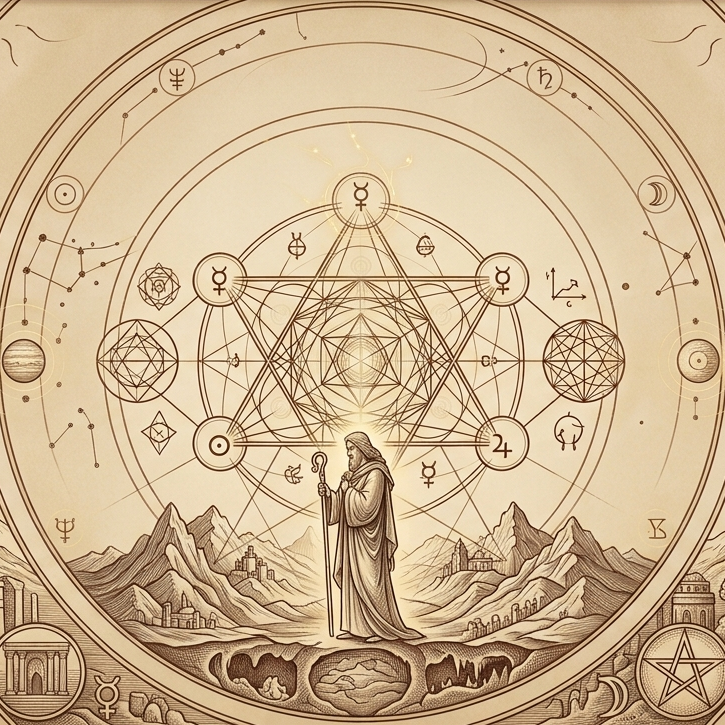
Through the ancient relationship between microcosm and macrocosm, we also discover that studying ourselves can become one path toward contemplating greater patterns, while observing the world around us can reveal symbols and relationships that help us better understand our own inner nature.
The Second Hermetic Principle gives us an important key for continuing our journey through Hermetic philosophy. Mentalism introduced the idea of a fundamentally mental universe within the philosophical system of The Kybalion. Correspondence then teaches us to search for relationships between different planes, recognizing that patterns may express themselves through different forms without those forms necessarily being identical.
Through the ancient relationship between microcosm and macrocosm, we also discover that studying ourselves can become one path toward contemplating greater patterns, while observing the world around us can reveal symbols and relationships that help us better understand our own inner nature.
Through the ancient relationship between microcosm and macrocosm, we also discover that studying ourselves can become one path toward contemplating greater patterns, while observing the world around us can reveal symbols and relationships that help us better understand our own inner nature.
The Second Hermetic Principle gives us an important key for continuing our journey through Hermetic philosophy. Mentalism introduced the idea of a fundamentally mental universe within the philosophical system of The Kybalion. Correspondence then teaches us to search for relationships between different planes, recognizing that patterns may express themselves through different forms without those forms necessarily being identical.
Through the ancient relationship between microcosm and macrocosm, we also discover that studying ourselves can become one path toward contemplating greater patterns, while observing the world around us can reveal symbols and relationships that help us better understand our own inner nature.
But another question now emerges. If different states and planes correspond to one another, what allows transformation and movement between different states? Why does nothing in nature remain permanently fixed, and how can one mental state gradually become another?
This leads directly to the Third Hermetic Principle: the Principle of Vibration, summarized in The Kybalion by the statement: “Nothing rests; everything moves; everything vibrates.” In the next article, we will explore what vibration means within Hermetic philosophy, how this principle relates to different states of matter and consciousness, and why the Hermetic tradition considers the understanding of vibration essential to the art of mental transmutation.
Until then, begin observing the correspondences already present in your own life. Do not use the mirror to blame yourself for everything that happens around you; use it to recognize the patterns you can actually transform. Sometimes the microcosm closest to us—our habits, thoughts, words and actions—offers the clearest starting point for understanding a much greater order.
Deepen Your Study with The Logos Code
If the Principle of Correspondence helps us understand the relationship between the inner and outer worlds, the next step is learning how intention can be given structure so that it does not remain confined to thought. This is precisely where the study of the Logos becomes especially important.
In The Logos Code, we explore the symbolism and knowledge associated with Thoth and examine the role attributed to word, sound and intention as instruments for organizing consciousness and directing action. The central purpose is not to treat manifestation as passive wishing, but to understand how inner intention can be translated into a coherent expression through thought, language and deliberate action.
When these elements begin to point in the same direction, Correspondence stops being merely something we study and becomes something we consciously practice. The inner world establishes the intention, the word gives that intention structure, and action anchors it in material experience.
If you want to deepen your understanding of these principles and explore how the Logos can be applied to consciousness, intention and the pursuit of a more ordered and abundant life, continue your journey with The Logos Code.